 |
|
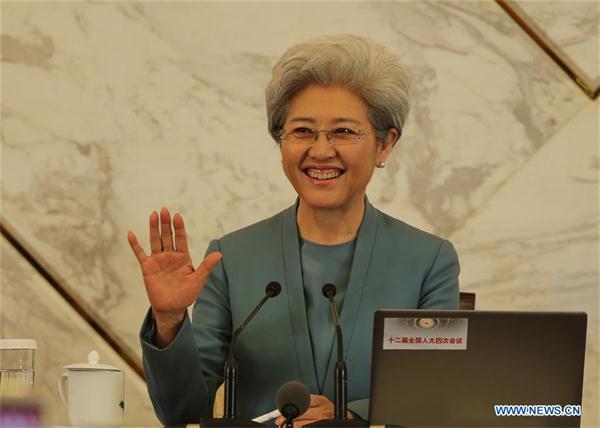
Fu Ying, spokesperson for the fourth session of China's 12th National People's Congress (NPC), attends a press conference on the session at the Great Hall of the People in Beijing, capital of China, March 4, 2016. The fourth session of the 12th NPC is scheduled to open in Beijing on March 5. [Photo/Xinhua] |
China will increase military expenditure by about 7 to 8 percent this year, according to Fu Ying, spokeswoman for the fourth session of the 12th National People’s Congress. No wonder it has drawn worldwide attention as usual despite it will be a slower growth than that in the past years.
In recent years, foreign critics have been most concerned about the modernization of China’s military, which is basically supported and guaranteed by the increase in its defense budget. But what these critics don’t understand is that China’s growing military capacity will not pose a threat to regional peace and security.
First, the increase in China’s defense budget is justified, especially because its military’s modernization has always been at an appropriate level.
China needs its armed forces to protect its peaceful development. This is important for maintaining peace and managing crises. China has to safeguard its sovereignty, security and development interests, and to deal with both traditional and non-traditional security threats. Given these facts, China has every reason to develop its military’s capabilities.
Militaries of all countries need to develop, for that is the global trend, and the Chinese military is no exception. Since China’s military is in the semi-mechanized/mechanized stage of development, it still lags behind others in terms of capacity. And it will take a long time to become a fully modernized force.
The Chinese military’s development is in proportion to its economic development, with the latter being the country’s priority.
Second, to determine whether a country’s military poses a threat to other countries, the key factor is not defense expenditure or the size and capability of its armed forces; instead, it is its defense policy and military strategy. A country with an aggressive policy could invade another country despite having a weaker military.
Another typical misconception about China’s military is that, since its missiles can strike a certain country, it is capable of destroying that country’s satellites and thus poses a threat to it. But the fact is, many countries have developed long-range strategic missiles, and the United States has the greatest capability of destroying other countries’ space assets, and its weapon systems can attack any country. So, is the US the greatest threat to the world?
Also, let us not forget that the US has 11 aircraft carriers while China has just one, which is not fully operational. It is, therefore, clear that it is a country’s defense policy that matters most whether it poses a threat to other countries. And China’s national defense policy has always been defensive in nature and its military strategy is to strike only when it is struck.
Third, since China has developed at an unprecedented pace because of a peaceful environment, it is committed to maintaining peace. China plans to double the average income of its people by 2020 compared with 2010 and become a mid-level developed country by 2050. All this can be achieved only in a peaceful environment — a conflict or war will disrupt the process.
Today we live in a world of shared destinies and interdependence. In the 21st century, no country, including China, can rise by using military force. More importantly, China is dedicated to the path of peaceful development, a defensive defense policy and a military strategy of active defense.
China has a chapter of history of being bullied, invaded and semi-colonized. As a result, it will never pursue expansionism or hegemonism.
And fourth, with a reasonable increase in its budget, the Chinese military will develop steadily to fulfill its domestic and international obligations and responsibilities. Besides, China’s military will continue to participate in UN peacekeeping missions, keep conducting escort and anti-piracy missions in the Gulf of Aden and other seas, as required, and work with other countries to maintain world peace.
The Chinese military is also committed to reducing risks, managing crises and controlling conflicts, so as to prevent untoward incidents that could disrupt peace and stability. With the growth in China’s national strength, its military will be better prepared to shoulder more international responsibilities, provide more public security services to the international community and contribute more to world peace and common development.
The author is an associate researcher with the Institute of Strategic Studies, National Defense University, PLA.



I’ve lived in China for quite a considerable time including my graduate school years, travelled and worked in a few cities and still choose my destination taking into consideration the density of smog or PM2.5 particulate matter in the region.
Copyright 1995 - . All rights reserved. The content (including but not limited to text, photo, multimedia information, etc) published in this site belongs to China Daily Information Co (CDIC). Without written authorization from CDIC, such content shall not be republished or used in any form. Note: Browsers with 1024*768 or higher resolution are suggested for this site.
License for publishing multimedia online 0108263 Registration Number: 130349