 |
|
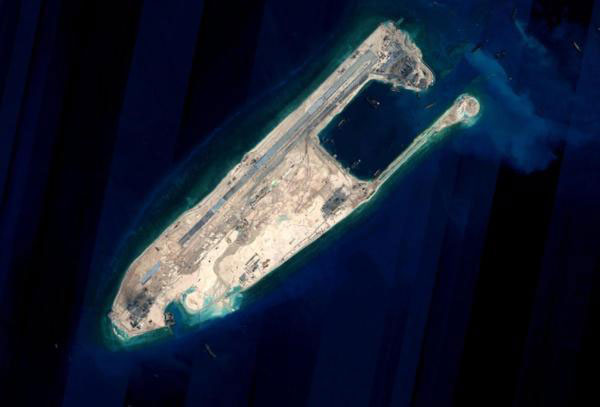
This satellite image shows the Yongshu Jiao of China's Nansha Islands. [Photo/Xinhua] |
Chinese Foreign Minister Wang Yi and his colleagues spare no effort, miss no opportunity, to clarify and defend the country's stance regarding the South China Sea.
But mostly they have to argue with Washington, a remotely relevant third party.
The quarrel with Washington is largely fruitless, and will hardly be fruitful, because it is centered on a US pretext that is inherently false.
Disputes over maritime rights and interests do exist in the East and South China Seas. But they are neither with the United States, nor about freedom of navigation, as it claims.
The war of words with Washington at least helps to reveal the feebleness of the latter's argument. Wang and his colleagues can avail themselves of the exchanges to clarify China's historical claims in the East and South China seas, and debunk accusations that this is a stronger, "assertive" China bullying its neighbors and challenging the US.
At the end of the day, deescalating tensions can't be accomplished without negotiations between the true stakeholders in the neighborhood. That is why two concurrent diplomatic developments on Monday deserve more of the limelight than the Beijing-Washington squabbles.
In Tokyo, vice-minister-level talks between Chinese and Japanese diplomats focused on pushing ahead political dialogue, which has been suspended at higher levels thanks to bickering over the Diaoyu Islands in the East China Sea.
While in Beijing, top leader Xi Jinping received a special envoy of the just-reelected general secretary of the Vietnamese Communist Party. Together they reiterated a shared commitment to properly handle their disagreements, and to make sure they do not get in the way of the traditional friendship between the two countries.
Political distrust between Beijing and Tokyo may be too deep and pervasive to dissolve swiftly. But the two have got along quite well for decades.
The territorial disputes between China and Vietnam may be too convoluted to quickly straighten out. But they have demarcated land boundaries to both sides' satisfaction.
Although immediate solutions may be unachievable, as long as the disputing parties are willing to sit down and talk, there will always be a way out.
But with more characters being dragged into the "freedom of navigation" farce in the South China Sea, things will inevitably become more complicated, and inflammable.
Ultimately the keys to peaceful solutions are in the hands of the claimant countries themselves, not those of third parties.
The troubles in the East and South China seas are equal parts competing for territorial claims and the deficiency of mutual distrust. One-on-one negotiations are thus essential to calm the increasingly muddy waters of the West Pacific.


Copyright 1995 - . All rights reserved. The content (including but not limited to text, photo, multimedia information, etc) published in this site belongs to China Daily Information Co (CDIC). Without written authorization from CDIC, such content shall not be republished or used in any form. Note: Browsers with 1024*768 or higher resolution are suggested for this site.
License for publishing multimedia online 0108263 Registration Number: 130349