 |
|
CAI MENG/CHINA DAILY |
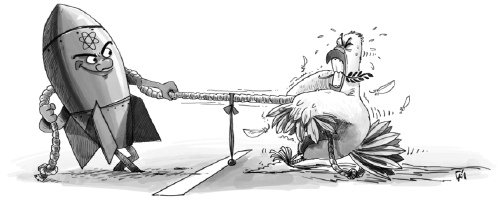
Chinese Foreign Minister Wang Yi revealed China's proposals to address the Democratic People's Republic of Korea's nuclear issues.
China is willing to discuss with all parties concerned the possibility of simultaneously pushing for the denuclearization of the Korean Peninsula, as well as the establishment of a peace mechanism in the region, said Wang. That is expected to involve a transition from the 1953 armistice on the Korean Peninsula to a permanent peace and security mechanism.
Since the Six-Party Talks have made little progress in denuclearizing the Peninsula and replacing the armistice with a peace treaty, Beijing, Washington, Pyongyang, and Seoul should seek to work on their own negotiations as soon as possible.
The "Four-Party Talks" would focus on establishing a peace mechanism, while the Six-Party Talks, should they resume, would seek to dissuade Pyongyang from pursuing its nuclear ambitions.
Undoubtedly Pyongyang is responsible for the escalating tensions, because of its consistent efforts to develop nuclear weapons. But Washington's flawed Peninsula policy and the de facto Cold War it is maintaining on the peninsula are also to blame.
Of course, these Four-Party Talks should not avoid the issue of the DPRK's nuclear program, but it should not make it a priority either, given that the US, ROK and DPRK are still hesitating over a peace mechanism.
The US and the ROK deem it might prove an unwanted signal to the international community that they acknowledge the DPRK's ownership of a nuclear arsenal. The DPRK is relatively more interested in the idea, yet refrains from making a denuclearization commitment.
Pyongyang's devotion to its nuclear program has not only been censured by the international community, but also resulted in severe economic sanctions being imposed on it. Now that it has shown interest in reentering the global economic order, negotiations and diplomatic meditation should try to find ways to help it, so that it voluntarily relinquishes its nuclear ambitions.
The deployment of the Terminal High Altitude Area Defense system, an advanced US anti-ballistic missile defense system, in the ROK, will pose a grave danger to the situation. It would almost certainly intensify the arms race between Seoul and Pyongyang, and even drag in key regional players such as Washington, Beijing, and Moscow. It would also deal a major blow to the China-ROK strategic partnership.
Therefore, the US and the ROK should suspend, if not terminate their plan for THAAD's deployment in the ROK, before it significantly shatters regional stability. Instead they should join with China and launch the Four-Party Talks, and work to resume the Six-Party Talks, which remain the key to defusing the rising tensions in Northeast Asia.
Wang Junsheng is an associate researcher at the National Institute of International Strategy, Chinese Academy of Social Sciences. The article is an excerpt of his interview with China Daily's Cui Shoufeng.



I’ve lived in China for quite a considerable time including my graduate school years, travelled and worked in a few cities and still choose my destination taking into consideration the density of smog or PM2.5 particulate matter in the region.
Copyright 1995 - . All rights reserved. The content (including but not limited to text, photo, multimedia information, etc) published in this site belongs to China Daily Information Co (CDIC). Without written authorization from CDIC, such content shall not be republished or used in any form. Note: Browsers with 1024*768 or higher resolution are suggested for this site.
License for publishing multimedia online 0108263 Registration Number: 130349