 |
|
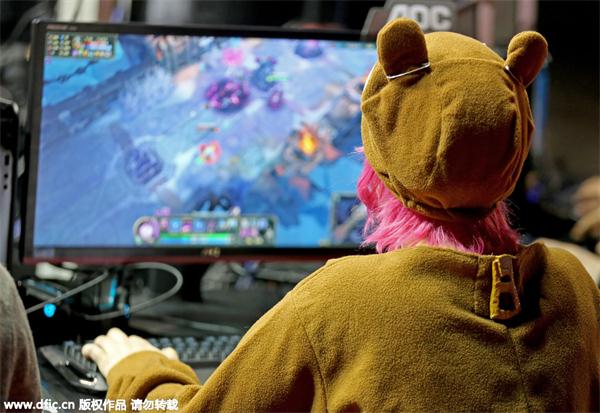
A young woman in a cat costume at the computer game festival 'DreamHack' in Leipzig, Germany, 22 January 2016. [Photo/IC] |
The latest China Audio-Video and Digital Publishing Association report shows the value of domestically developed cyber-game software in 2015 reached 140.7 billion yuan ($21.38 billion), 22.9 percent more than in 2014. And the overseas sales of cyber-game software increased 72.4 percent year-on-year to reach $5.3 billion.
There can be no doubt that China's cyber-game industry is on the rise. A large population with wide access to computers and the Internet grants China incomparable advantage in developing the cyber-game industry: reports show China had 534 million cyber-game players in 2015, making it a top choice for many global cyber-game events.
The 2012 and 2013 World Cyber Games, the cyber world's Olympics, were held in Kunshan, East China's Jiangsu province. Before that, Chengdu, Southwest China's Sichuan province, had played host to the 2009 games.
However, many in China consider cyber-games evil, claiming they affect students' performance and harm children's eyesight and health. Others claim the violent contents in cyber-games tend to make youngsters unruly and could even push them toward crime. There is no scientific evidence, though, to prove that cyber-games tend to make youngsters violent.
No wonder the central authorities are changing their attitude toward cyber-games. In 2013, the General Administration of Sport formed a team of 17 players to join the Fourth Asian Indoor Games in South Korea. One year later, the GAS held the first National Electronic Sports Open, which many consider a milestone in China's cyber-game history.
China's cyber-game industry is not without drawbacks, however. Domestic cyber-game developers are yet to come up with software that can gain global popularity. Of the 14 cyber-games adopted by the World Cyber Games, none is "made in China". Moreover, the cyber-games developed by Chinese companies are rather short-lived compared with their global competitors.
The 2015 China Audio-Video and Digital Publishing Association report does not mention it, but the fact is, many domestic companies are interested in making quick money and leave their cyber-games to "die a natural death" in a few months or years. Though there is no official list, players recently compiled a widely recognized roll of "40 classic cyber-games", none of which was developed by a Chinese company.
The future for the Chinese cyber-game industry, therefore, is full of both opportunities and challenges. And the cyber-game industry needs to change to successfully take on global competitors.
The author is a writer with China Daily.
zhangzhouxiang@chinadaily.com.cn



I’ve lived in China for quite a considerable time including my graduate school years, travelled and worked in a few cities and still choose my destination taking into consideration the density of smog or PM2.5 particulate matter in the region.
Copyright 1995 - . All rights reserved. The content (including but not limited to text, photo, multimedia information, etc) published in this site belongs to China Daily Information Co (CDIC). Without written authorization from CDIC, such content shall not be republished or used in any form. Note: Browsers with 1024*768 or higher resolution are suggested for this site.
License for publishing multimedia online 0108263 Registration Number: 130349