 |
|
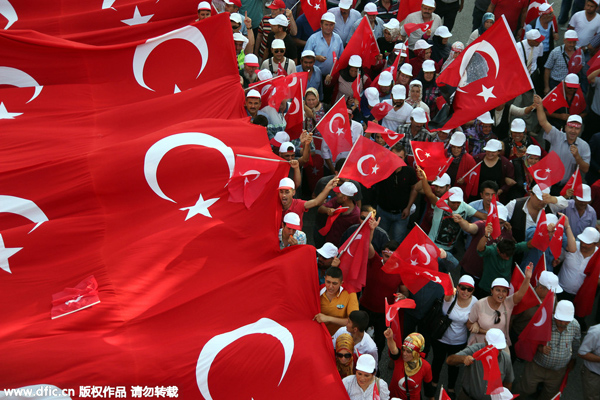
More than 10,000 people marched with a gigantic Turkish flag against terrorist attacks to security forces in Turkey's capital city Ankara, Sept 17, 2015. [Photo/IC] |
The new year is just three weeks' old and terrorist attacks have already rocked Indonesia, Burkina Faso, Pakistan and India, not to mention those in Iraq and Afghanistan. Terrorism is no longer confined to a few countries; it is wreaking havoc across continents and has become a threat to global stability and peace. This calls for leaders across the world to put up a joint fight against terrorist groups, especially the Islamic State group.
That terrorists are launching attacks randomly indicates they are trying to not only consolidate their bases but also hit back at the anti-terrorism alliance.
On the one hand, the IS group's strategic focus has shifted from occupying large swathes of northern Iraq and Syria to launching "lone-wolf" and sporadic attacks in, say, one city, which is a typical al-Qaida tactic. On the other hand, the European Union seems to be fighting IS terrorists within its borders as a considerable number of them have managed to take advantage of the loose border control to enter European countries.
Objectively speaking, the expansion of terrorist networks has been curbed because of the efforts of the international community, which, however, has made little substantial progress in its yearlong military strikes against IS targets. The two combines fighting the IS group, the United States-led coalition and the four-nation alliance comprising Russia, Syria, Iran and Iraq, have struggled to efficiently coordinate their actions.
Washington is obviously inclined to avoid further direct intervention in the Middle East, fearing it might get involved in open conflicts in the region again. Burdened by an extensive economic downturn, the ongoing Ukrainian crisis and the influx of Middle East refugees, the EU too has refrained from intensifying its attacks on the IS.
Likewise, some major Middle East countries fighting the IS have to give way to their own concerns. In other words, the so-called war against the IS has become more like a fractured clash of civilizations, in which almost every member appear to be using the war as a convenient excuse to marginalize the "real" enemy or enemies.
On the bright side, the war against terrorism is gaining fresh momentum - so are the efforts to resolve the Syrian crisis - as more countries have decided to pitch in. In response to the horrendous attacks in Paris in November, the G20 summit issued a statement on Nov 16 to combat terrorism, which aims to cut off the IS financial supply routes and impose stricter sanctions on the secret financers.
This was followed by the UN Security Council unanimously passing resolutions urging member states to "take all necessary measures" to prevent and suppress the violent acts of the IS and other terrorist groups. Major powers such as the US, France and Russia have also increased their strikes on IS targets, and Saudi Arabia has announced the formation of a 34-state Islamic military coalition to combat terrorism.
The IS can be eliminated in the near future should all countries deepen their cooperation and closely coordinate their actions under the UN framework. But it would take more than military operations, intelligence sharing, financial sanctions and judicial coordination to claim victory.
As a new terrorist outfit, the IS has more channels across the globe, online and offline both, for raising funds (it is even using Internet crowd-funding). So the international community has to make more concerted efforts to disable the IS' financing network and prevent the backflow of people who joined terrorist groups overseas into their home countries.
The author is a professor at the International Politics Department of the University of International Relations in Beijing.



I’ve lived in China for quite a considerable time including my graduate school years, travelled and worked in a few cities and still choose my destination taking into consideration the density of smog or PM2.5 particulate matter in the region.
Copyright 1995 - . All rights reserved. The content (including but not limited to text, photo, multimedia information, etc) published in this site belongs to China Daily Information Co (CDIC). Without written authorization from CDIC, such content shall not be republished or used in any form. Note: Browsers with 1024*768 or higher resolution are suggested for this site.
License for publishing multimedia online 0108263 Registration Number: 130349