 |
|
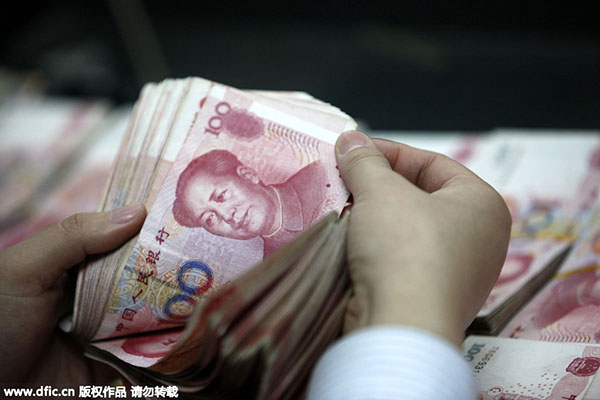
A Chinese clerk counts yuan banknotes at a bank in Huaibei city, East China's Anhui province, Jan 22, 2015.[Photo/IC] |
The recent turmoil in the currency market involving the renminbi and concurrent volatility in China's stock markets reminds me of the remark that James Tobin, the late Nobel laureate in economics, made right after the Asian financial crisis occurred in 1997: "The Asian economies are victims of a flawed international exchange rate system that, under US leadership, gives the mobility of capital priority over all other considerations."
It is commonly accepted in the West that free capital movement has become one of the axioms of modern global capitalism since the so-called Reagan-Thatcher revolution. As a result, despite the ample evidence of the inherent risks of short-term free capital flows, policymakers of the leading economies have seemed unable to look much beyond the assumption that the ideal world is one of free capital flows.
The late eminent economic historian Charles Kindleberger characterized short-term capital flows as "manias, panics, and crashes"; and history shows that such volatile capital flows were the major culprit in many financial crises. In the current environment characterized by increased globalization of financial markets and free capital flows, such traditional indicators of sound macroeconomic fundamentals as government budget balance, subdued inflation, and high domestic saving rates have become increasingly inadequate to prevent financial crises.
The weight of historical evidence clearly points toward restraint on capital flows, especially for emerging economies such as China which has been built by and for "patient capital". Money that pours into a country can just as easily pour out. Highly volatile short-run capital, often moved by self-fulfilling waves of euphoria or panic, can disrupt economies and cause massive swings in exchange rates.
The Economist has calculated that if only 5 percent of China's population decided to move the current per-person limit of $50,000 per year abroad, China's foreign exchange reserves would evaporate. If this happened, the international value of the renminbi would surely collapse, causing "a gratuitous unnecessary tragedy" not only to China but also to the interdependent global economy.
Some speed bumps, or "sand in the market's gears", should be imposed on short-term capital flows. Emerging economies such as China should maintain capital controls, permitting foreign direct investment while eschewing "hot money". It is an ideological humbug to argue that without free mobility of volatile short-term capital economies cannot function and their growth rates will collapse.
The writer is professor of finance and international business at the Stillman School of Business of Seton Hall University, New Jersey, and visiting professor at the University of International Business and Economics, Beijing.
The opinions expressed here are those of the writer and don't represent views of China Daily website.


Copyright 1995 - . All rights reserved. The content (including but not limited to text, photo, multimedia information, etc) published in this site belongs to China Daily Information Co (CDIC). Without written authorization from CDIC, such content shall not be republished or used in any form. Note: Browsers with 1024*768 or higher resolution are suggested for this site.
License for publishing multimedia online 0108263 Registration Number: 130349