 |
|
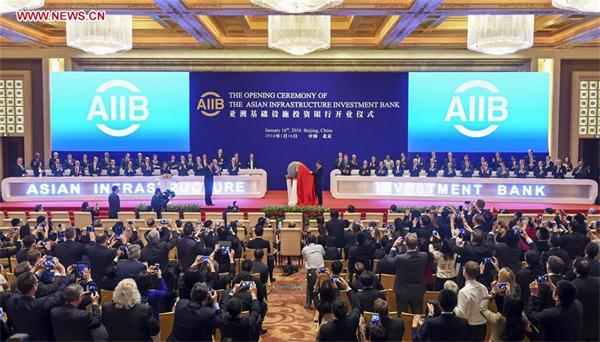
Chinese President Xi Jinping (C) unveils a symbol sculpture of the Asian Infrastructure Investment Bank (AIIB) at the opening ceremony in Beijing, capital of China, Jan 16, 2016. [Photo/Xinhua] |
The Asian Infrastructure Investment Bank, which is operational now, will open up new opportunities for vast infrastructure projects in Asia. The 57-member infrastructure financial institution of the new bank is the brainchild of China, and with an initial capital of $100 billion it is expected to play a major role in promoting connectivity leading to regional integration. In the long term, it will raise China's profile on the global stage.
Member states of the Association of Southeast Asian Nations, which are all founding members of the AIIB, would be the main beneficiaries because they have numerous projects waiting for funding, especially those that have been identified under the Master Plan of ASEAN Connectivity. According to the Asian Development Bank, ASEAN will need $60 billion a year to finance the required infrastructure projects.
At their recent summit in Kuala Lumpur, ASEAN leaders discussed how to find alternative ways for funding their infrastructure projects. So far, all the support has come from government sources, but at the moment it is hard to come by. The ASEAN leaders agreed that financial institutions and the private sector should be further explored to get the required funds.
ASEAN's connectivity master plan has identified 15 priority projects, including the ASEAN Highway Network and Singapore-Kunming Railway. But these projects would soon be updated reflecting the changes that took place in the past year.
After the master plan was approved in 2010, ASEAN set up its own infrastructure fund worth $485 million, of which $335 million came from ASEAN and the rest from the ADB. The fund is the biggest ASEAN-led initiative. However, for the past five years ASEAN has been trying to promote public-private partnership investment as a framework for these projects without much success.
It remains to be seen whether the AIIB will make it easy for developing countries, especially ASEAN member states, to get loans in addition to those given by traditional financial institutions. Countries liked Indonesia and the Philippines have infrastructure projects, especially road and port construction, which need urgent funding. Given the AIIB's focus on the whole of Asia, key shareholders, such as China, India and Russia which hold 30.34 percent, 8.52 percent and 6.66 percent of the shares, would have a lot of say in deciding which projects to support.
The AIIB's operation will be a test for China's new international role, for it has adopted strong policies on governance, transparency and accountability to become a higher profile player on the global stage. This, in a way, is a work in progress.
The warm welcome the AIIB got from the region and beyond after it was proposed in 2013 was indicative of the huge support the financial initiative has got. But its lending policies and the projects it selects for funding will reveal its nature, as well as show whether it will complement the traditional multilateral institutions or play a unique role.
ASEAN fears that the China-led super-infrastructure project known as the Belt and Road Initiative could dampen the grouping's chance of getting more funding. But China wants to utilize its multilateral project to promote connectivity, trade and investment. For example, over land, it will help develop China's relatively backward southwestern region and link it up with the outside world to improve facilities for its exports.
Recent months have seen strong reactions from the region to China's latest attitude toward the South China Sea disputes. But despite being critical of China's attitude and conflicting in their opinions, ASEAN members have not refused to engage with the AIIB. The establishment of ASEAN Community at the end of last month has also transformed the bloc into a single production-based region with 630 million people. And foreign investors are likely to be attracted to a bigger market with bigger returns.
The Year of the Monkey will prove to be a decisive year for China's foreign policy as Beijing continues to extend its political and economic influence across the world, especially in the region.
The author is a senior fellow at Chulalongkorn University's Institute of Security and International Studies.



I’ve lived in China for quite a considerable time including my graduate school years, travelled and worked in a few cities and still choose my destination taking into consideration the density of smog or PM2.5 particulate matter in the region.
Copyright 1995 - . All rights reserved. The content (including but not limited to text, photo, multimedia information, etc) published in this site belongs to China Daily Information Co (CDIC). Without written authorization from CDIC, such content shall not be republished or used in any form. Note: Browsers with 1024*768 or higher resolution are suggested for this site.
License for publishing multimedia online 0108263 Registration Number: 130349