 |
|
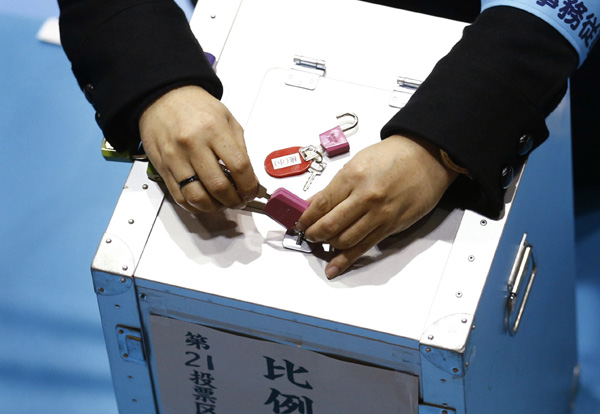
An election official unlocks a ballot box at a counting centre in Tokyo, December 14, 2014. [Photo/Agencies] |
Japan welcomed 1.21 million 20-year-olds into adulthood on Jan 11. But two years before their coming of age, Japan's young people will have the right to vote for the Upper House election in summer. The country's Diet enacted legislation in July 2015 to lower the minimum voting age to 18 from 20-the biggest reform of the nation's electoral laws in 70 years. The change is expected to add 2.4 million voters to Japan's voting pool.
The Japanese government claims that the change is important as the "voices of young people will be more reflected in politics".
The legislative change came as the ruling Liberal Democratic Party headed by Prime Minister Shinzo Abe seeks to revise the country's war-renouncing Constitution for the first time since it took effect in 1947.
In an interview with Japan's public broadcaster NHK on Jan 10, Abe said he is aiming to ensure that the ruling coalition - the LDP and Komeito - and some opposition parties in favor of constitutional amendment will secure at least two-thirds of the seats in the Upper House. Half of the 242 Upper House seats are open for grabs every three years. The ruling coalition already holds more than two-thirds of the seats in the Lower House.
The LDP and other right-leaning parities take the upcoming Upper House election as a golden opportunity to gain the political momentum for constitutional change.
Article 96 of Japan's Constitution states that constitutional amendments require two-thirds support in both the lower and upper houses of the Diet, and must be ratified by a national referendum.
The LDP, which called for constitutional revisions as part of its election platform, drew up a draft of a new Constitution, including changes to the war-renouncing Article 9, in 2012.
On Feb 4, 2015 when talking with Hajime Funada, chair of the Headquarters for the Promotion of Revision to the Constitution for the LDP, Abe said it would "make sense" to submit a constitutional amendment to the Diet after the elections for the Upper House.
It was the first time that Abe has mentioned a specific time frame for the amendment, a sign that the Japanese government intends to start moving forward with its efforts to revise Japan's Constitution.
If the LDP and its coalition partner had a two-thirds majority in the Upper House, progress toward amending the Constitution could proceed swiftly, moving from a vote in the Diet to a public referendum.
However, the LDP and the like-minded parties have alarmed legal experts and ordinary Japanese who see no need to amend the Constitution and undermine Japan's pacifist credo.
Japan's defense and security policies have long been bound by the country's pacifist Constitution, with war-renouncing Article 9 forming the backbone.
But the Abe administration has eased the rules on arms exports and reinterpreted the Constitution to enable the exercise of the right to collective self-defense. Japan's Diet has enacted two security-related bills, expanding the roles of Self-Defense Forces overseas.
The public is against any drastic reworking of Japan's security and defense policies, which they fear would snare Japan into war. The backlash against the security bills is a case in point. College students staged massive protests against Abe's push to enact the security bills last year, sponsoring weekly rallies near parliament to protest against the bills. The students have eyed the July 2016 Upper House election, as a chance to weaken the LDP's grip on power.
The lower minimum voting age means a larger voting pool. But the new blood may not necessarily support the LDP and its coalition partner in their intention to amend Japan's Constitution.
The author is China Daily Tokyo bureau chief.
caihong@chinadaily.com.cn



I’ve lived in China for quite a considerable time including my graduate school years, travelled and worked in a few cities and still choose my destination taking into consideration the density of smog or PM2.5 particulate matter in the region.
Copyright 1995 - . All rights reserved. The content (including but not limited to text, photo, multimedia information, etc) published in this site belongs to China Daily Information Co (CDIC). Without written authorization from CDIC, such content shall not be republished or used in any form. Note: Browsers with 1024*768 or higher resolution are suggested for this site.
License for publishing multimedia online 0108263 Registration Number: 130349