 |
|
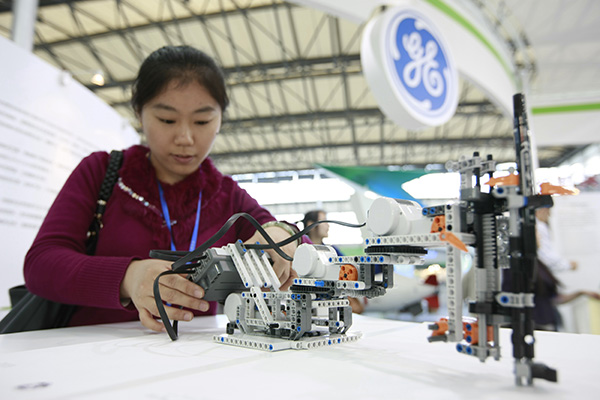
A woman inspects a robot designed by General Electric during a recent industrial fair in Shanghai. Despite the slowdown in China's economic growth, the US company is confident that the Chinese market will continue to expand. [Photo provided to China Daily] |
China will begin its 13th five-year economic plan next year in an environment where it is expected the economy could growth around 6.5 percent a year, encountering several challenges that the authorities need to confront.
First, the "new normal" stage of economic growth, where the economy would grow around 6.5 percent instead of the 10 percent growth rate it used to, would mean that the service sector would have to take the slack of the industrial sector, and internal demand (internal consumption mainly) should do the same for external demand.
Second, the aim of having a less resource-consuming and environment-friendly economy would mean tackling factory overcapacity in several industries such as steel, cement, automobiles, and this would require finding new sources of growth in energy-clean industries and technologically advanced industries.
Third, the easy and cheap money available due to the several monetary stimulus implemented by the Chinese government would came to an end and instead of this some fiscal support such as infrastructure investment and corporate tax breaks for specific industries in the so-called supply-side reforms would be needed.
Fourth, in the external environment the end of cheap and abundant dollar finished when the Federal Reserve in US began increasing its interest rate and this is having effects like the cooling of growth of many emerging economies that were buyers of Chinese goods. The deceleration of Chinese economy itself has also mean that many emerging economies that were dependent on demand of China for their primary goods, now with less foreign exchange, would buy less Chinese goods.
While facing those challenges, China has its own edges to overcome them. First, China could keep steady development despite of some negative factors mentioned above for example by also making a reality the "One Belt one Road initiative" and putting fully operational the Asian Infrastructure Investment Bank. These measures could spur an infrastructure boom abroad and benefit Chinese companies and demand for Chinese goods.
In the internal side, the growing urbanization of the country can began having greater favorable effects in the economy with the limited relaxation of the "hukou" system by giving some migrants workers official residence status to settle in the cities and began enjoying the advantages of being urban residents. This together with the relaxation of the one-child policy, could increment internal consumption, occupancy of some unused property and increase labor supply.
Second, China could continue opening its economy reducing more its tariffs and non-tariff barriers and in this way introduce more foreign competition for its companies. Especially some State-owned companies that are not profitable should streamline its operations so in this way could represent less a burden for the fiscal position of the country.
Cheaper and better foreign goods will also improve living standards as demand for them is high as shown by the shopping spree when Chinese go abroad.

Charlotte and Emilie Meaud, twin sisters, were killed at the terrace of the Carillon, during the attacks on Paris, on the 13th of November.

Copyright 1995 - . All rights reserved. The content (including but not limited to text, photo, multimedia information, etc) published in this site belongs to China Daily Information Co (CDIC). Without written authorization from CDIC, such content shall not be republished or used in any form. Note: Browsers with 1024*768 or higher resolution are suggested for this site.
License for publishing multimedia online 0108263 Registration Number: 130349