 |
|
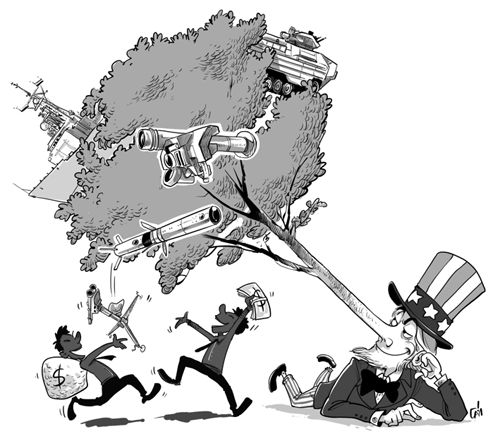
CAI MENG/CHINA DAILY |
The Barack Obama administration has just authorized another round of arms sales to Taiwan worth $1.8 billion, which Beijing has strongly opposed because it undermines the country's sovereignty and national integrity.
China has maintained this position since Beijing and Washington normalized their diplomatic relationship, and demanded that the US immediately stop selling arms to the island.
In fact, the US had promised to reduce the quantity and quality of arms sales to the island once the tensions across the Taiwan Straits eased, and eventually stop them. But 33 years after the US made the promise, in the form of the third China-US Communiqué in 1982, Washington has been continuing to sell weapons sales to Taiwan. It has been violating its promise despite the easing of tensions across the Straits, and the peaceful and massive two-way flow of people and goods.
The US may argue that the Chinese mainland's rise poses a greater "threat" to Taiwan, which warrants it to continue selling arms to the island. In the same vein, one could also argue that, as the world's sole superpower, the US automatically is the greatest threat to the world. But this logic is too simplistic.
The mainland's rise may have been dramatic, but it has not changed its intent of a peaceful reunification with Taiwan. The mainland has made it absolutely clear that it would adhere to a non-peaceful approach only in the event of Taiwan's de jure independence. Otherwise, Beijing remains committed to promoting peaceful interaction in partnership with the Chinese compatriots in Taiwan. The recent meeting between Xi Jinping and Ma Ying-jeou in Singapore is proof such efforts are based on the principle of one-China.
No matter in which way you look at the cross-Straits relations, they are China's internal affair, not part of international relations, and do not brook outside interference. Despite this, China has adopted a cooperative approach for decades in the hope of bringing about peaceful reunification.
Based on this understanding, Beijing has been working with Washington on various bilateral, regional and global issues, and their collaboration has significantly benefited both sides, as well as the rest of the world.
Nevertheless, the US has neither respected China's legitimate rights bestowed by the UN Charter nor kept its promise on the Taiwan question. Washington's actions have made it an untrustworthy partner and undercut its legitimacy as a world power.
While the US keeps telling others to abide by international law, it itself is unwilling to abide by the UN Charter. To justify its weapons sales to Taiwan, it has resorted to the "Taiwan Relations Act", its domestic public law, which conflicts with the principle of established international norms.
China has been suggesting to the US to build a "new type of major power relationship", but apart from its occasionally positive reaction, Washington has not done much.
Since such a relationship should be based on the principle of non-confrontation, and mutual respect and mutual benefit, the US can at least learn to treat China as a rising power, if not a major power. The US should know that by preferring to confront China, it will also cause harm to itself.
The mainland authorities have announced sanctions against those entities that conduct arms deals with Taiwan, which means they will lose ongoing businesses with the mainland and potentially lose more opportunities to tap one of the top markets in the world.
China reserves the right to intensify the sanctions later. And even though this would reduce mutual benefit across the Pacific, China as a rising power is willing to bear the cost in order to punish those who don't care about others' legitimate interests.
The author is a professor at and associate dean of the Institute of International Studies, Fudan University, Shanghai.



I’ve lived in China for quite a considerable time including my graduate school years, travelled and worked in a few cities and still choose my destination taking into consideration the density of smog or PM2.5 particulate matter in the region.
Copyright 1995 - . All rights reserved. The content (including but not limited to text, photo, multimedia information, etc) published in this site belongs to China Daily Information Co (CDIC). Without written authorization from CDIC, such content shall not be republished or used in any form. Note: Browsers with 1024*768 or higher resolution are suggested for this site.
License for publishing multimedia online 0108263 Registration Number: 130349