 |
|
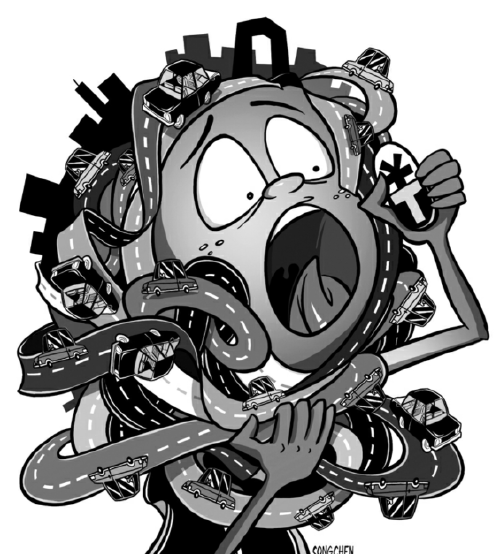
Song Chen/China Daily |
The concept of a congestion charge is not new. Cities such as London and Singapore introduced congestion charges years ago, and they have, to some extent, eased traffic jams in those cities' central districts.
Can Beijing successfully impose such a charge on drivers to solve its traffic problems?
Let us take Singapore as an example. Singapore has less than 1 million cars while Beijing has more than 5.59 million. Some people may argue that Beijing is spread over 16,410 square kilometers while Singapore is only about 700 sq km. But let us not forget that Beijing's main urban area, that is the area within the Fifth Ring Road, is similar to the area of Singapore's main island-and a majority of Beijing's vehicles park inside these urban areas.
Besides, most of China's central departments are located in this area, and quite a high percentage of drivers who live outside this area have to travel to the center of the city almost every day. As a result, the number of vehicles per sq km in Beijing is much higher than in Singapore, and that's the root cause of the traffic jams in the capital.
Since the number of cars has exceeded the capacity of the city, the only way of easing traffic jams is to limit the number of vehicles.
A congestion charge is one of the measures aimed at discouraging people from driving into the central business district. But there is a problem: If the congestion fee is too small, it will account for a small percentage of the cost of owning and driving a car, and thus will not help reduce traffic. And if the congestion fee is too high, the public may not support the policy.
As such, the congestion charge won't help much in reducing traffic. The ultimate solution to the congestion problem thus lies in other creative measures.
The author is a professor of public governance at Renmin University of China.



I’ve lived in China for quite a considerable time including my graduate school years, travelled and worked in a few cities and still choose my destination taking into consideration the density of smog or PM2.5 particulate matter in the region.
Copyright 1995 - . All rights reserved. The content (including but not limited to text, photo, multimedia information, etc) published in this site belongs to China Daily Information Co (CDIC). Without written authorization from CDIC, such content shall not be republished or used in any form. Note: Browsers with 1024*768 or higher resolution are suggested for this site.
License for publishing multimedia online 0108263 Registration Number: 130349