 |
|
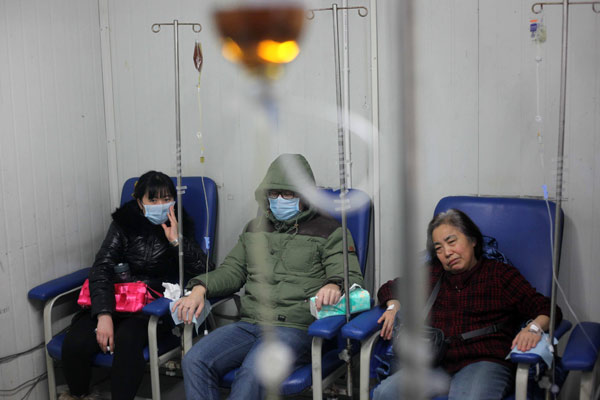
Flu patients get intravenous drip at the China-Japan Friendship Hospital in Beijing, Jan 10, 2013.[Photo by Wang Jing/Asianewsphoto] |
Last month, all of China applauded Tu Youyou as she was awarded the Nobel Prize in Medicine for her work in developing a drug that is now used globally to treat malaria. In 1945, the same prize was awarded to three scientists for producing the world's first antibiotic, penicillin.
The discovery of penicillin was one of the single most important advances in the history of medical science. Antibiotics have revolutionized modern medicine by making previously incurable illnesses like pneumonia, scarlet fever and tuberculosis and life-threatening infections treatable. Countless lives have been saved over the last 70 years as a result.
Today, antibiotics have become a victim of their own success. Antibiotics have been used so extensively that many are becoming powerless against diseases they used to cure. Like other once bright, shiny, new tools, antibiotics have become worn out-and less effective and incisive over time simply because we haven't used them right. Bacteria are increasingly resistant to existing antibiotics, and while new drugs have been developed, the pace of discovery has not kept up with the pace of bacterial resistance.
It is difficult to imagine a world without effective antibiotics, but that is where we are headed without firm action now to preserve the power of existing antibiotics. Infectious diseases which have mostly been relegated to the history section of the medical museums could emerge to become common killers again; the risk of untreatable infections will make common surgical procedures like caesarian sections potentially life-threatening. World Health Organization director-general Margaret Chan has described antibiotic resistance as "one of the greatest challenges for global public health today".
Beyond the health system, the economic costs of antibiotic resistance-for instance, in premature deaths and loss of workplace participation and productivity-pose serious threats to economic growth and development.
Antibiotic use has historically been very high in China compared to other countries. There are a number of reasons for this, including the pressure doctors faced to make money from prescribing drugs because their salaries were low. Public awareness about the correct use of antibiotics is also low: for instance, nearly two-thirds of Chinese respondents in a survey commissioned by WHO thought antibiotics were effective against colds and flu (despite the fact that antibiotics have no impact on viruses). Common misconceptions like this have led to incorrect use of antibiotics, and the emergence of antibiotic resistance.



I’ve lived in China for quite a considerable time including my graduate school years, travelled and worked in a few cities and still choose my destination taking into consideration the density of smog or PM2.5 particulate matter in the region.
Copyright 1995 - . All rights reserved. The content (including but not limited to text, photo, multimedia information, etc) published in this site belongs to China Daily Information Co (CDIC). Without written authorization from CDIC, such content shall not be republished or used in any form. Note: Browsers with 1024*768 or higher resolution are suggested for this site.
License for publishing multimedia online 0108263 Registration Number: 130349