 |
|
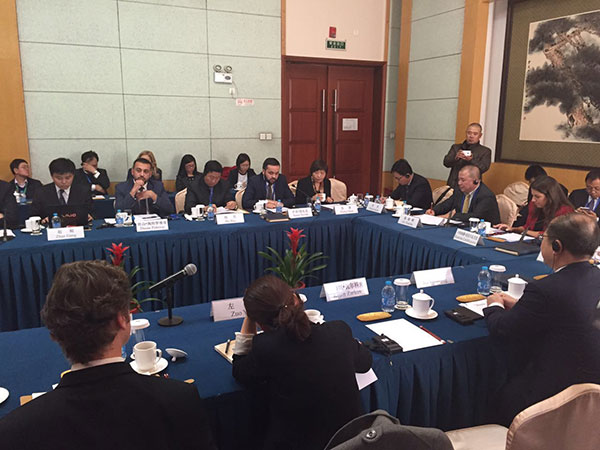
Central and Eastern European country representatives talk about the opportunities and challenges they are facing in a panel discussion on October 30, 2015. [Photo/China Daily] |
Editor's note: The fourth Meeting of the Heads of Government of China and Central and Eastern European Countries on Nov 24-25 holds a lot of promise. The following are some experts' opinions about how China's Belt and Road Initiative could benefit the CEE countries:
Align Belt and Road with other European states' development plans
The year 2015 marks a defining moment in cooperation between China and Central and Eastern European countries, or "16+1 Cooperation", mainly for two reasons.
The first is the Fourth Meeting of Heads of Government of China and CEE Countries, which will be held for the first time in China, and the second is promotion of China's Belt and Road Initiative.
The 16+1 Cooperation ranked very high in China's foreign strategies in the context of the Silk Road Economic Belt and the 21st Century Maritime Silk Road (or Belt and Road Initiative).
CEE countries are located in the western part of the Silk Road Economic Belt, and China's proposal in 2012 to develop a framework of comprehensive mutual relations with these countries effectively signaled beginning of the 16+1 Cooperation.
Since then the 16+1 Cooperation has helped deepen mutual political trust, built cooperation mechanisms and frameworks, and developed practical collaboration among all parties.
China's government and enterprises have explored approaches for cooperation and identified the priority areas. In fact, China is now capitalizing on these experiences by drafting a mid-term 16+1 Cooperation Program.
The country is also expected to seek additional opportunities for transnational infrastructure cooperation projects such as the Hungary-Serbia Railway and the extended network of China-Europe Land-Sea Express Line, as well as international industrial cooperation projects in the CEE region.
Compared with some areas in the grip of political and military conflicts along the Belt and Road, the CEE region is relatively peaceful and has stable markets.
But China will have to face some challenges in pushing forward the Belt and Road Initiative in the CEE countries, the biggest arguably being how to deepen mutual political trust with the 16 countries and their global stakeholders.
China is trying to align the Belt and Road Initiative with the CEE countries' national development strategies to identify common economic interests, which will strengthen the mutual relations with these countries.
China is also making efforts to align Belt and Road Initiative with the European Union's infrastructure development strategy, such as the Juncker Plan and the Berlin Plan, by proposing industrial cooperation with the EU in the CEE region.
The alignment of the Belt and Road Initiative with the Eurasian Economic Union is aimed at dispelling any doubts Russia may have over China's initiatives, in order to brighten the prospects of China's cooperation with the Balkan states.
Coordination and cooperation in this diverse region is not easy to achieve. However, this challenging endeavor provides China with an opportunity to test and put to use its political wisdom and traditional philosophy of respect, inclusiveness and mutual benefit.
Liu Minru is an associate researcher in the Central Compilation & Translation Bureau of the CPC and visiting scholar at the Institute for Security & Development Policy in Sweden.



I’ve lived in China for quite a considerable time including my graduate school years, travelled and worked in a few cities and still choose my destination taking into consideration the density of smog or PM2.5 particulate matter in the region.
Copyright 1995 - . All rights reserved. The content (including but not limited to text, photo, multimedia information, etc) published in this site belongs to China Daily Information Co (CDIC). Without written authorization from CDIC, such content shall not be republished or used in any form. Note: Browsers with 1024*768 or higher resolution are suggested for this site.
License for publishing multimedia online 0108263 Registration Number: 130349