 |
|
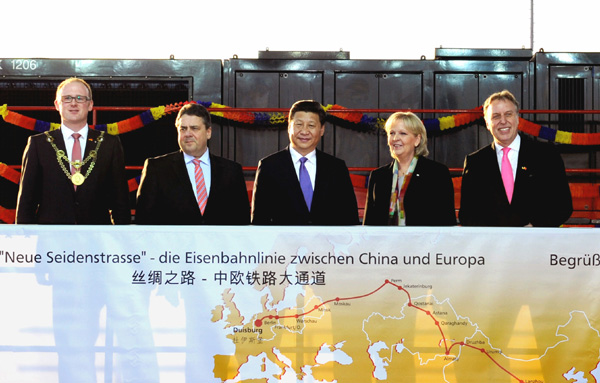
Chinese President Xi Jinping (center) visits Port of Duisburg of Germany March 29, 2014. [Photo/Xinhua] |
The European Union faced serious economic challenges over the past few years, but the majority of the Central and Eastern European countries have now returned to their high growth patterns after the financial crisis, compared with the more developed western EU member states.
The primary focus of the CEE countries during the years of their political and economic transformation was the successful integration with the western European institutional framework. The turbulences following the financial crisis, however, encouraged regional governments to diversify their economic relations and strengthen cooperation with the global powers of the Eastern hemisphere as well.
The China-led Belt and Road Initiative, the Silk Road Economic Belt and 21st Century Maritime Silk Road, meets the strategic orientation of the governments of the CEE region. Facilitating these mutual interests, a multilateral cooperation mechanism has been set up within the "16+1" framework to strengthen economic and diplomatic ties among the participating countries.
As a sign of its new foreign policy approach, the Hungarian government announced its Eastern Opening policy in 2011 with the aim to boost economic cooperation with the rapidly growing regions of Asia. The policy is Hungary's answer to the challenges faced by the world economy and to the realignment in international relations.
Although the CEE countries differ in many aspects, their historical and social ties provide a strong foundation for further cooperation. The strategic geographical position of the region allowed the establishment of major transit routes running through the CEE countries for thousands of years.
For example, the Amber Road - which was mainly developed during the rule of the Roman Empire about 2 millenniums ago - made the transportation of amber and other valuable raw materials possible from the Baltic region to Italy. The road stretching more than 1,500 kilometers between its two end points, utilized the most developed technology of the time: a 5-meter wide paved highway. The Amber Road played a significant role in the economic development of the region while facilitating intercultural relations between the Roman provinces and the surrounding countries.
Besides the favorable geographical location, the region - supported by its highly qualified, yet comparably low-cost labor force - offers unique business opportunities to foreign investors. As a result, Chinese investments in the CEE countries has shown remarkable growth over the past decade and played an important role in the region's recovery from the immediate effects of the financial crisis. Chinese foreign direct investment in the region was only $43.7 million in 2004, but it had surpassed $2 billion by 2013, playing a key role in these economies' restructuring.
The CEE countries can play an important role in the successful implementation of the Belt and Road Initiative. The financial assets in the Silk Road Fund dedicated to realizing infrastructure developments related to the New Silk Road can benefit not only the states where the actual investments are made, but also the region as a whole. It can facilitate the economic integration of the region as well as create new business opportunities for Chinese companies.
As an integral part of the Belt and Road Initiative, the planned Budapest-Belgrade high-speed railway will cut travel time by half on this 350-km-long segment of the strategic transportation corridor between the cargo port of Piraeus in Greece and western Europe. According to the proposed schedule, the railroad could be operational by the end of 2017, which would not only be an important infrastructure development project for the flow of international trade, but could also facilitate stronger and more effective cooperation between the national governments of the region.
Like the historical Silk Road that was - for thousands of years - much more than a mere channel for the transportation of goods between China and Europe, the New Silk Road could also become a major catalyst for strengthening cultural and technological ties between Asia and Europe while strengthening trade and economic relations among the participating countries.
The author is a political economist and strategic analyst in the Cabinet Office of the prime minister of Hungary.



I’ve lived in China for quite a considerable time including my graduate school years, travelled and worked in a few cities and still choose my destination taking into consideration the density of smog or PM2.5 particulate matter in the region.
Copyright 1995 - . All rights reserved. The content (including but not limited to text, photo, multimedia information, etc) published in this site belongs to China Daily Information Co (CDIC). Without written authorization from CDIC, such content shall not be republished or used in any form. Note: Browsers with 1024*768 or higher resolution are suggested for this site.
License for publishing multimedia online 0108263 Registration Number: 130349