 |
|
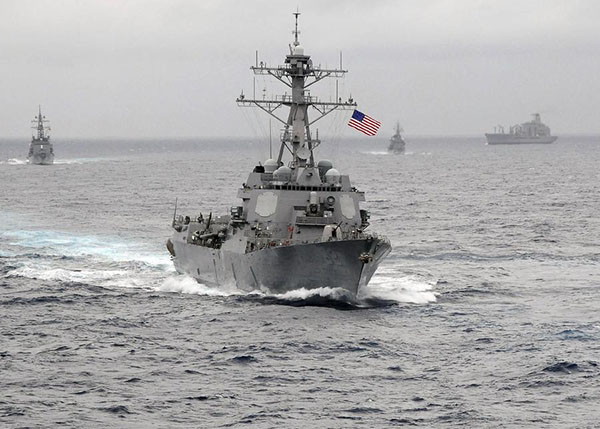
The US Navy guided-missile destroyer USS Lassen sails in the Pacific Ocean in a November 2009 photo provided by the US Navy. [Photo/Agencies] |
The South China Sea is one of the busiest sea lanes in the world used by China, Japan, the Republic of Korea and many other countries, including the United States, and keeping it open is in the best interest of all. The shipping lane has never suffered disruptions despite the disputes among various countries over islands, reefs, and maritime rights and interests.
Still, the US has a fundamental disagreement with China over freedom of navigation. And the real reason for disagreement is the protracted close-range military reconnaissance and other operations by the US. Since US actions endanger China's national security, the latter is naturally opposed to them. Late last month, the US further intensified the disagreement over freedom of navigation by sending its warship to patrol the waters near the islands where China has carried out reclamation work.
On the handling of South China Sea-related issues, the White House, the US Department of State and the Department of Defense have some differing views. But the views of the Defense Department and the US Pacific Command seem the toughest.
Their belligerent views could be a symbolic stance to satisfy China bashers and get more budgetary funds. Or, they could signify their intention of turning the military operations in the South China Sea into a regular affair, gradually increasing their scale and intensity. Although both possibilities are provocative, the latter will greatly increase the risks of China-US frictions in the South China Sea. So, while waiting to see what exactly the US is after, China must prepare for a long-term struggle in case the US pursues the second path.
Compliance or non-compliance with the UN Convention on the Law of the Sea aside, the entry of the US warship into the waters near China's islands sends a strong negative signal: that the US considers China an adversary or even a potential enemy.
The disputes in the South China Sea are rather complicated. China has disputes over islands, reefs and/or maritime rights and interests with five Southeast Asian countries (with Indonesia, it only has a dispute over maritime rights or interests). Given the situation, China has not set its territorial sea base points or drawn the baseline for islands and reefs in the South China Sea; they remain ambiguous to a certain extent. This shows China has been exercising utmost restraint and sincerely hopes to resolve the disputes through peaceful dialogue.



I’ve lived in China for quite a considerable time including my graduate school years, travelled and worked in a few cities and still choose my destination taking into consideration the density of smog or PM2.5 particulate matter in the region.
Copyright 1995 - . All rights reserved. The content (including but not limited to text, photo, multimedia information, etc) published in this site belongs to China Daily Information Co (CDIC). Without written authorization from CDIC, such content shall not be republished or used in any form. Note: Browsers with 1024*768 or higher resolution are suggested for this site.
License for publishing multimedia online 0108263 Registration Number: 130349