 |
|
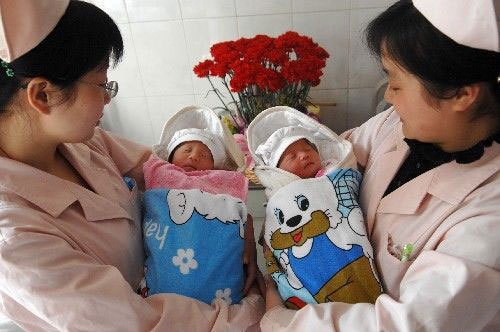
Two nurses hold baby boy and girl twins at a hospital in Hefei, Central China’s Anhui province. [Photo/Xinhua] |
By the time you finish reading this article, a newborn infant will have died somewhere in the Western Pacific Region. This death, like many others, might have easily been prevented, and at minimal cost, through a package of simple, low-cost interventions starting with the first embrace - the simple act of ensuring skin-to-skin contact between mother and baby immediately after birth.
It sounds almost too good to be true. But there is compelling evidence that shows, a mother's first embrace, the sustained skin-to-skin contact between mother and baby straight after birth - the first step in early essential newborn care - can make the difference between life and death. This is the focus of a new online campaign, "First Embrace", the World Health Organization is launching in China this week.
When a newborn baby comes out of the womb, he or she is extremely vulnerable - immediately at risk, for example, from cold (hypothermia) and a host of harmful bacteria in the delivery room. Yet, contrary to the natural maternal instinct, the baby is often taken away from the mother right after birth, so that healthcare professionals can examine the baby and perform other important tasks. Of course, such care is incredibly important, but often the importance of sequence is misunderstood.
When a baby is born, he or she first needs to be quickly dried and then passed straight back to the mother, for the essential skin-to-skin contact which transfers love, warmth and protective bacteria. It also helps to promote breastfeeding which builds immunity and lowers the risk of noncommunicable diseases in the future. It is the first step in building the special bond between mother and child that will last a lifetime. And, time and time again, in different situations and different countries, it has been clinically proven to work in improving health outcomes for newborn babies.
For many, the birth of a newborn child represents the happiest moment in our lives. But, heartbreakingly for those families involved, more than 150,000 newborns die every year across the country. This is 150,000 newborn deaths too many. But the same statistics that frustrate also provide hope: Many such tragedies could be prevented if the right measures are adopted, both at birth and during the first week of life.
China has achieved remarkable success in reducing newborn deaths in recent decades - a public health feat of which the country is justifiably very proud. But of those infant deaths which tragically still do occur, the majority occur in the first week after birth. We can do more to stop this, including through wider adoption of the package of early essential newborn care measures that WHO has developed to reduce newborn deaths across the region.
In the last two decades, China has made incredible progress in extending healthcare - including maternal and child healthcare programmes - to the farthest corners of the country. But the benefits of this progress have not been shared evenly. Just last week, The Lancet medical journal published new research highlighting the inequities in health outcomes across the country: In places such as Shanghai, child and maternal health outcomes rival those the United States and Canada; in other parts of China, the statistics look more like those of poor countries such as Bangladesh.
The "First Embrace" approach can help to overcome at least some of these inequalities. It will be just as effective for infants born in a Beijing hospital as it will be for a home birth in a rural community in Qinghai province. The first embrace is a simple, evidence-based measure that can help to ensure that every baby born in China gets the best possible start in life.
The author is World Health Organization Representative in China.



I’ve lived in China for quite a considerable time including my graduate school years, travelled and worked in a few cities and still choose my destination taking into consideration the density of smog or PM2.5 particulate matter in the region.
Copyright 1995 - . All rights reserved. The content (including but not limited to text, photo, multimedia information, etc) published in this site belongs to China Daily Information Co (CDIC). Without written authorization from CDIC, such content shall not be republished or used in any form. Note: Browsers with 1024*768 or higher resolution are suggested for this site.
License for publishing multimedia online 0108263 Registration Number: 130349