 |
|
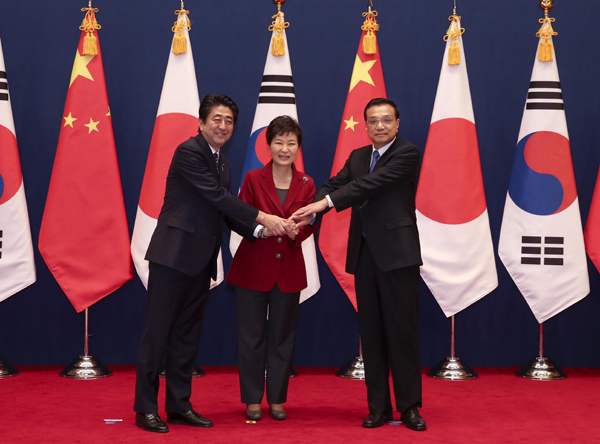
Chinese Premier Li Keqiang (right), Japanese Prime Minister Shinzo Abe (left) and South Korean President Park Geun-hye (center) shake hands during the sixth China-Japan-ROK trilateral meeting in Seoul, Nov 1, 2015. [Photo/Xinhua] |
The trilateral meeting between the leaders of China, Japan and Republic of Korea on Sunday has given us optimism, though cautious, about reconciliation in East Asia.
Shigeo Iwatani, a veteran Japanese diplomat and former secretary-general of the Trilateral Cooperation Secretariat, believes that frequent meetings will help buildup the personal relations between Chinese and Japanese leaders. Based on improved personal trust, the two countries can then discuss pending issues or, even better, might find solutions to them.
Iwatani's words remind me of the chemistry that first led to a better relationship between China and Japan. The friendly personal connections paralleled the friendly bilateral relations. China and Japan got along for a decade when they managed their differences well.
Leaders of the two countries met for the first time in 1972, and negotiated to normalize the bilateral relations.
US scholar Ezra Vogel has previously compared Chinese leader Deng Xiaoping's trip to Japan in 1978 to US president Richard Nixon's trip to China in 1972. He commented that just as only Nixon could have opened relations with China, only Deng could have managed to move forward China's relations with its former enemy Japan.
Yasuhiro Nakasone visited China for the first time as Japanese prime minister in 1984. Beyond politics, he and Chinese senior leader Deng Xiaoping had a candid and touching conversation about the latter's career in the Communist Party of China and the difficulties he faced during the "cultural revolution" (1966-76).
Nakasone was an ambitious prime minister who sought to transform Japan's position in the international system. He favored a pro-active foreign policy, trying to position Japan as the key player in East Asia and in global affairs. Developing a deep, meaningful dialogue with China was integral to his diplomatic strategy.
Nakasone was one of the first Japanese conservative politicians to visit China in 1954. He came to China again in 1973 and then in 1980.
In Nakasone's eyes, close Sino-Japanese relations were "the basis for peace in the Asian region, and... a powerful pillar for world peace". Deng Xiaoping called for both sides to see the big picture of the bilateral relations.
Keeping their disagreements from turning into barbs, China and Japan had a valuable exchange of views and proposed to cooperate.
When he delivered a speech at Beijing University on March 24, 1984, Nakasone announced that Sino-Japanese relations would abide by the "four principles" of peace and friendship, equality and mutual benefit, mutual trust and long-term stability.
The Sino-Japanese relationship, however, was not without frictions in the 1980s. Nakasone visited the controversial Yasukuni Shrine on August 14, 1985 in his official capacity as prime minister, inviting protests from China and the ROK.
Despite the problems in their relations, the two countries tried to remain on the same page with an eye on a bigger picture.
Now strategic suspicion has made it difficult for them to handle their divergences.
The leaders agreed on the important principle of "increasing trust and reducing suspicion" in 2000. But this has been easier said than done.
Engaging at all levels can help the two countries find the seeds of misunderstandings and get to know each other better.
The author is China Daily's Tokyo bureau chief. caihong@chinadaily.com.cn



I’ve lived in China for quite a considerable time including my graduate school years, travelled and worked in a few cities and still choose my destination taking into consideration the density of smog or PM2.5 particulate matter in the region.
Copyright 1995 - . All rights reserved. The content (including but not limited to text, photo, multimedia information, etc) published in this site belongs to China Daily Information Co (CDIC). Without written authorization from CDIC, such content shall not be republished or used in any form. Note: Browsers with 1024*768 or higher resolution are suggested for this site.
License for publishing multimedia online 0108263 Registration Number: 130349