 |
|
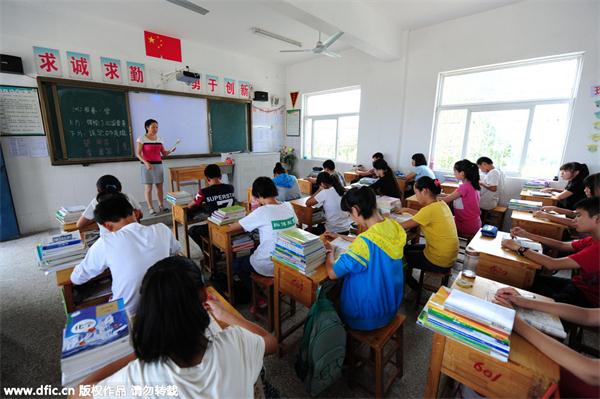
A young female teacher teaches students in class in a rural village. [Photo/IC] |
During the 12th Five-Year Plan (2011-2015) period, China's fiscal expenditure on education reached 4 percent of GDP (in 2012). The historical increase in expenditure has improved the condition of rural schools, narrowing the education gap and promoting equal access to education.
But we should have a clear understanding of the current spending on education and how to improve the quality of education and give students equal access to education.
In 1993, China's Education Reform and Development Outline decided to increase the expenditure on education to 4 percent of GDP by the end of 2000. But the goal was achieved in 2012, more than one decade later. The global average expenditure on education is 4.9 percent of a country's GDP — even in undeveloped countries the average is 4.1 percent.
Therefore, to improve the quality of education and give all students access to education, as proposed by the National Education Plan in 2010, China has to increase the education expenditure to 4.5 percent or even 5 percent of GDP.
Some people say China has already "paid off" its educational debts. But this is not correct. China started spending 4 percent of its GDP on education only in 2012. As a result, it has plenty of educational "debts" of the preceding 12 years to repay. And these educational debts directly influence the quality and fairness of education in China.
Only in 2008, for example, China implemented free compulsory education in the true sense of the term. Besides, the education imbalance between urban and rural areas is still very serious.
A set of data released during the 2014 annual sessions of the National People's Congress and Chinese People's Political Consultative Conference showed the combined fiscal budget for education of governments at all levels was 2.4 trillion yuan ($377.45 billion), but the actual expenditure was only 2.29 trillion yuan. This exposed the unscientific use of education funds in recent years.
It is important to increase expenditure on education, but it is more important to ensure the proper use of the education funds. So, additional spending on education should be used to pay the remaining educational debts, such as construction and reconstruction of schools in rural areas, increasing the benefits of teachers and helping students in rural areas. For example, it is difficult for rural schools to attract talents because of the low salary.
To ensure enough spending on education and its proper use, China should focus on three major aspects in its 13th Five -Year Plan (2021-2025). First, is should establish central and local education fund allocation committees, which will be in charge of and supervise the budgets and use of education funds. Such committees are important for guaranteeing proper spending on education and its effective use.
Second, the focus of national fiscal spending on education should shift from higher education to basic education, and the authorities should make the distribution of education resources fairer. This is to say that the spending on basic education should be increased and more education funds used to run all existing schools well instead of building super or key schools. And the money to be spent on higher education should come from social funds, because it will help create more space for the development of higher education.
Third, the entire education fund security system should be reformed. For years for the central government has focused on developing higher education while the spending on basic education has been the responsibility of township and county governments.
This has led to serious educational imbalance. In recent years central funds for fiscal transfer payment to support rural education have increased, but generally township and county authorities still have to bear the expenditure on basic education.
So, to narrow the education gap among different areas, the central government should increase the transfer payment and help provincial and regional authorities' strengthen their finances for rural basic education.
The author is vice-president of the 21st Century Education Research Institute.


Copyright 1995 - . All rights reserved. The content (including but not limited to text, photo, multimedia information, etc) published in this site belongs to China Daily Information Co (CDIC). Without written authorization from CDIC, such content shall not be republished or used in any form. Note: Browsers with 1024*768 or higher resolution are suggested for this site.
License for publishing multimedia online 0108263 Registration Number: 130349