 |
|
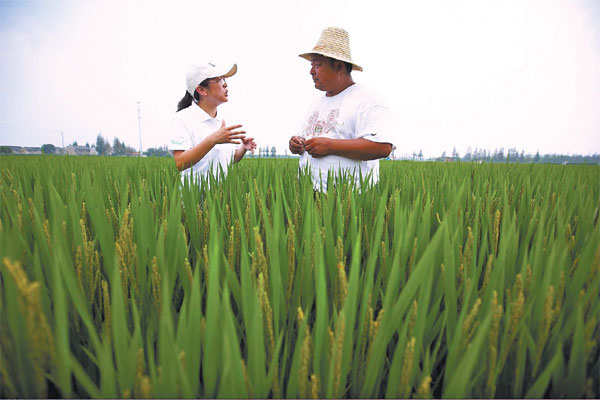
The central government is investing more in biotechnology and working with foreign companies to boost farm production. Photos provided to China Daily |
The Belt and Road Initiative offers even more opportunities for agriculture exchanges than the ancient Silk Road. The initiative will generate huge investments in logistics and transport infrastructure to improve connectivity, paving the road for transporting agricultural produce in a more cost effective and time efficient way. This will substantially facilitate agricultural trade in the coming decades. Furthermore, the agriculture sector contributes directly to enhancing both access to food and incomes for the most vulnerable households in developing countries, as such it can readily serve as the entry point for broader based cooperation.
Within this framework, China and its Belt and Road partner countries – most of which are rich in agricultural recourses – are presented with historical opportunities to forge a new paradigm of agricultural cooperation. One that focuses on transforming agriculture and food systems by enhancing the efficiency and effectiveness of resources and inputs in a sustainable manner, and sharing the agricultural knowledge and technology that plays a transformational role in enhancing local food security and market availability.
China's impressive food production achievements – consecutive record grain harvests for the past 11 years – have been strenuously achieved with the constraints manifesting themselves conspicuously in an overstressed agricultural environment, exacerbated by land and water shortages and compounded by high production costs.
As such, the government recently adopted a two-pronged strategy to ensure China's food security: maintaining fundamental self-sufficiency in staple foods, while tapping international markets to supplement its food security efforts. This creates enormous opportunities for agricultural cooperation with partner countries, each of which is at different stages of agricultural and economic development. Collectively these countries boast diverse arable land and water resources, food consumption habits and production potential.
Therefore, the Belt and Road Initiative constitutes a platform for China and its partner countries to share knowledge, upscale best practices in a bid to foster an open, inclusive, mutually-beneficial and all-win partnership for long-term food security not only during the coming 13th Five-Year Plan (2016-20) period, but also beyond.
Within the portfolio of investments, agricultural cooperation will no longer be confined to production per se. Rather the new paradigm of cooperation will be based on an integrated value approach, covering a host of up and downstream industries, including logistics, processing, storage, seed varieties and breeding stock development. The reliable food value chains in the Belt and Road economies will ensure access to safe food and facilitate agricultural trade. In the meantime, local farmers' participation in the food value chains should be adequately addressed to make sure that they will benefit directly from food trade and value-added processing activities.
Environmental concerns and sustainability should take precedence over the short term goals of quick production increases. While crop yields in some central Asian countries, for example, have substantial potential to increase, crop intensification, or more precisely the degree of intensification, should be handled with great care, bearing in mind the serious resultant negative externalities of overuse of fertilizers and agrochemicals in some areas in China.
The region has its own hard lessons to learn, such as the Aral Sea ecological disaster, which has been mainly caused by the overambitious drive for irrigation. In this regard, China can share its good practices in arid and semi-arid agriculture development, particularly its water-saving irrigation technologies, which integrate agronomic, management and engineering considerations.
Along the Belt and Road, the new wagon of agricultural cooperation, powered by the wheels of complementarities, an integrated value approach, sustainability and win-win results, may usher in a new era outshining the glory of ancient Silk Road.
The author is a senior economist with the Food and Agriculture Organization of the United Nations.



I’ve lived in China for quite a considerable time including my graduate school years, travelled and worked in a few cities and still choose my destination taking into consideration the density of smog or PM2.5 particulate matter in the region.
Copyright 1995 - . All rights reserved. The content (including but not limited to text, photo, multimedia information, etc) published in this site belongs to China Daily Information Co (CDIC). Without written authorization from CDIC, such content shall not be republished or used in any form. Note: Browsers with 1024*768 or higher resolution are suggested for this site.
License for publishing multimedia online 0108263 Registration Number: 130349