 |
|
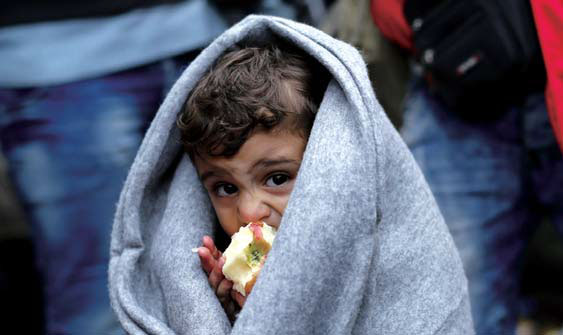
A migrant child eats an apple as he waits next to the Croatian border near the village of Berkasovo, Serbia. [Photo/Agencies] |
According to the United Nations Refugee Agency, among the over 19.5 million refugees across the globe by the end of 2014, the majority were from the Middle East, where at least 8.9 million have fled their war-torn homelands.
By this month, about 4.1 million people from Syria had been registered and granted temporary protection mainly in neighboring countries such as Turkey, Lebanon and Iran, which respectively host at least 1.6 million, 1.1 million, and 980,000 refugees from the region. In contrast, only 500,000 (and counting) Middle East refugees have entered the European Union, but that has already made many member states balk.
It requires a considerable sum of money to accommodate and employ these refugees, let alone guarantee their children's education. The influx of a variety of Middle East refugees has also given rise to political disparities within the countries that plan to take them in, as well as latent risks with regard to local security and interracial exchanges.
The relationships between countries that receive, export, and transfer asylum-seekers also face strong headwinds as they fail to reach a consensus on how to tackle the ongoing migrant crisis. German Chancellor Angela Merkel has been losing support at home since she decided to take in more refugees.
True, some Middle East states in transformation have a lot to deal with at home - clashes between different classes, tribes, and races. But it is indisputable that the frequent military interventions led by the West, including the United States and Europe, have fueled the chaos that has forced people from their homes.
Given the significance of energy resources - especially in the future contest of national strength between emerging economies - the oil-rich Middle East nations do have an advantage because they can easily forge alliances to fight their rivals by manipulating the supply and price of petrol. That is exactly why the West has been bent on interfering with Middle East affairs.
On the one hand, it instigated the "Arab Spring" to promote "democracy" in the Arab World, mostly via cellphones and the Internet; on the other, US-led military actions have more than once overturned "disobedient administrations", such as the ones ruled by Saddam Hussein in Iraq and Muammar Gadhafi in Libya.
These misdeeds eventually resulted in the latest refugee crisis, which to many Europeans was an unexpected outcome. In fact, the EU had started transforming the Middle East not long after the end of the Cold War in the early 1990s, for example, launching the "Barcelona Process" in 1995 and the 2008 "Mediterranean Union" of the Mediterranean Summit.
Likewise, Washington has been keen on promoting the Arab Spring in the Arab world, using its military might to overthrow regional nationalist regimes. In 2004 it floated the concept of a "Greater Middle East", in which the wars in Afghanistan and Iraq served as integral parts.
To oust the legitimate Syrian President Bashar al-Assad, the US government has offered financial aid and weapons to the country's opposition forces, including, in 2014, over $500 million for training fighters. Unfortunately, crippling the Syrian government has not only led to endless turmoil and civil war in the country, but also exposed the local residents to an unchained bloodthirsty monster - the Islamic State group.
As Angus Deaton, an economist at Princeton University and the 2015 Nobel laureate in economics pointed out, Europe's immigration crisis is a result of unequal development, and might be alleviated in a short time if the political disparities and obstacles between the countries are resolved.
The refugee crisis will keep haunting all involved parties unless wars and poverty are eliminated in the war-stricken countries, which urgently need peace and stability to restore their economies and convince their nationals that seeking asylum elsewhere is no longer necessary. That being said, major Western powers have to stop intervening to their own liking in Middle East affairs before the regional situation spins out of control.
The author is a professor in Middle East Studies at the Chinese Academy of Social Sciences and a council member of a think tank affiliated to the Institute of Middle East Studies, Shanghai International Studies University.



I’ve lived in China for quite a considerable time including my graduate school years, travelled and worked in a few cities and still choose my destination taking into consideration the density of smog or PM2.5 particulate matter in the region.
Copyright 1995 - . All rights reserved. The content (including but not limited to text, photo, multimedia information, etc) published in this site belongs to China Daily Information Co (CDIC). Without written authorization from CDIC, such content shall not be republished or used in any form. Note: Browsers with 1024*768 or higher resolution are suggested for this site.
License for publishing multimedia online 0108263 Registration Number: 130349