 |
|
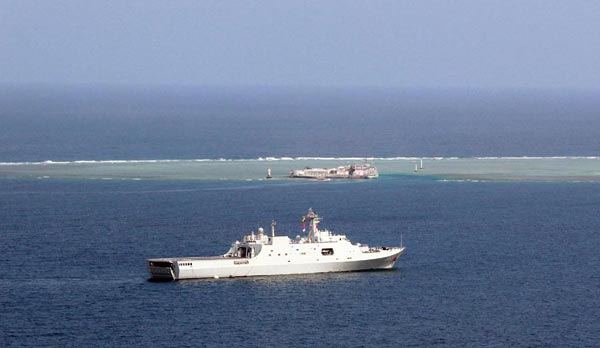
A formation of the Nanhai Fleet of China's Navy on Saturday finished a three-day patrol of the Nansha islands in the South China Sea. [Photo/Xinhua] |
Since last week, US military officials and government spokespersons have raised their tone about sending the US warships within 12 nautical miles of the islands where China has recently done reclamation work in the South China Sea. Their provocative comments have once again beefed up tensions in the waters.
To justify its move, the United States has not hesitated to use "freedom of navigation" as a pretext. It even went further and wrongly criticized China's reclamation work as "militarization" of the waters.
With its high-profile interference in the South China Sea, Washington is trying to achieve several purposes: dressing up Uncle Sam as a defender of "freedom of navigation" in the disputed waters, reinforcing the US' role as a responsible power which is helping small countries like the Philippines to stand up to the "bullying" Chinese, and last but not least, throwing mud at China and playing up the "China threat" cliche, so the US can implement its strategic rebalancing to Asia in a bolder manner and further consolidate its military presence in the region.
Unfortunately, all these will prove to be vain hopes as the US justifications for its preannounced operations are based neither on truth or reason.
"Freedom of navigation" is never an issue of concern in the South China Sea. Given that most of its flow of commerce in foreign trade passes through the sea lanes in the region, China cares as much as others, if not more, about "freedom of navigation" in the South China Sea.
China's reclamation work on some of the islands and reefs in the South China Sea facilitates freedom of navigation, instead of impeding it. The work is mainly for maintenance, improving the living conditions of the stationed personnel and providing common goods to the international community by offering services to foreign ships sailing in the region. For example, the lighthouses on Huayang and Chigua reefs, which went into operation on Oct 10, have significantly improved navigational safety in the waters.
Hence, there is no need to make a fuss about China's reclamation work.
And for the US to do so is hypocritical, given that over the years the Philippines and Vietnam have built on far more islands and reefs in the disputed waters than China, and the US has never said a word about them.
As to the US accusation that China is militarizing the waters, it is unfounded as well as absurd. China has repeatedly said it has no intention of militarizing the waters. It does not need a security expert to point it out that militarizing the waters would only worsen the security situation for China's.
Instead, it is the US which has been militarizing the waters step by step in recent years. As the world's sole superpower, it has both displayed its military muscle and made clear its strategic intention which is tantamount to militarizing the waters.
The US has raised both the frequency and scale of its joint war games with allies in the region. Its military aircraft and vessels have never ceased conducting reconnaissance along China's coastlines, not to mention that it has vowed to deploy 60 percent of its naval and air forces to the Asia Pacific region by 2020.
What the US has done so far is evident that it is using regional territorial disputes, the South China Sea issue in particular, as a stepping stone to implement its rebalancing to Asia strategy.
If Washington goes ahead with its planned operation, it will heighten the risks of a misjudgment and undercut efforts to seek diplomatic resolutions to the disputes. Neither prospect contributes to peace and stability in the South China Sea, which the US says it is trying to maintain.
The author is a senior writer with China Daily. wanghui@chinadaily.com.cn


Copyright 1995 - . All rights reserved. The content (including but not limited to text, photo, multimedia information, etc) published in this site belongs to China Daily Information Co (CDIC). Without written authorization from CDIC, such content shall not be republished or used in any form. Note: Browsers with 1024*768 or higher resolution are suggested for this site.
License for publishing multimedia online 0108263 Registration Number: 130349