 |
|
SONG CHEN/CHINA DAILY |
Editor's Note
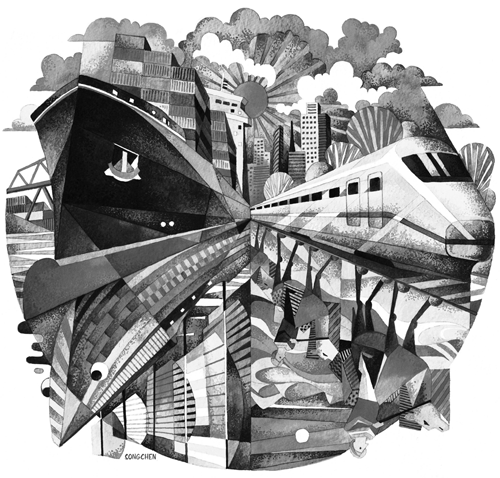
: The Belt and Road Initiative proposed by China is expected to bring big opportunities to the countries and regions involved. But what are the challenges the initiative faces and what are the prospects for its development in the near future? The China Institutes of Contemporary International Relations recently held a seminar on the Initiative; the following are excerpts of some of the participating experts' views:China proposed the Belt and Road Initiative more for economic reasons than political or strategic needs. And the initiative mainly serves the economic interconnectivity needs of Eurasia. It will connect the Asia-Pacific, where China is a main global producer, with the Middle East and Far East, which are main suppliers of resources, and the European Union, which is a major high-end consumption region. That process will propel the formation of a high-level value chain in Eurasia.
The initiative is not without challenges though, and a major one is how to coordinate among the different economies along the Silk Road Economic Belt and the 21st Century Maritime Silk Road. China needs to try to link the initiative with the involved countries' strategies, including Russia's Eurasian Economic Union, Kazakhstan's Bright Road, South Korea's Euroasia Initiative and India's Cotton Route.
It is necessary and urgent to strengthen rule-making for the initiative in platforms such as the Shanghai Cooperation Organization, BRICS and ASEAN 10+1, and via bilateral or trilateral free trade agreements. The Belt and Road Initiative is open and inclusive to the countries and regions along it and beyond.
Another huge challenge lies in how to raise enough funds and how to earn revenue to cover the huge cost of its realization. Many of the nations along the Belt and Road lag far behind in terms of basic infrastructure and it might take trillions of dollars to improve them.
Doubtlessly the Asian Infrastructure Investment Bank, the Silk Road Fund, and the New Development Bank will provide support. However, the funds that they can raise are far from enough and more support from professional, international funding agencies is required. That job might exceed one generation and may require the efforts of several generations.
Fu Mengzi, vice-president of the China Institutes of Contemporary International Relations
A key part of the Belt and Road Initiative is to promote economic growth and propel cooperation on production capacity. As the first step, China plans to jointly build six economic corridors so as to connect China, Russia, Mongolia and other Asian nations with each other. The industrial parks of Chinese enterprises in these countries will serve as the main platforms for cooperation.
In propelling the process, it must be noted that Eurasian countries vary hugely in terms of economic conditions, governing political philosophies, as well as current infrastructure. Therefore, both the Chinese government and Chinese enterprises need to draw up individualized plans to cooperate with different countries so as to make the cooperation more efficient.
Sharing the same objective of development, economies along the Belt and Road Initiative have different interests and how to coordinate among them will be a major challenge. Besides, the traditional and nontraditional security threats in the region must also be properly dealt with, so that they do not interrupt the cooperation among them. To sum up, the Belt and Road Initiative must serve different countries in their pursuit of common interests so as to win wide support and be truly multinational.
Chen Dongxiao, president of the Shanghai Institutes for International Studies
The Belt and Road Initiative can be propelled at four levels. At a basic level, it needs to interconnect the infrastructure of the countries involved to coordinate technology and resources.
At the financial level, China needs to decrease the risks by promoting stable and open financial cooperation with the relevant countries, and improve the international monetary system with a greater diversification of currencies.
That leads to the rule-writing level. Most of the existing international rules are not neutral and serve the interests of the US-led developed countries. The international regimes need to be reformed so the rules are fairer; the Belt and Road Initiative offers a good platform for that. Besides, reform of the international monetary arrangements can also lower the trade costs between China and relevant countries, thus benefitting all.
Maybe after years' efforts, China can start interacting with relevant nations at the fourth level, namely the conceptual one. China is a strong advocator of free trade. Through the Belt and Road Initiative, China can help make the idea of free trade more popular and boost regional growth.
Zhang Yuyan, director of the Institute of World Economics and Politics at the Chinese Academy of Social Sciences



I’ve lived in China for quite a considerable time including my graduate school years, travelled and worked in a few cities and still choose my destination taking into consideration the density of smog or PM2.5 particulate matter in the region.
Copyright 1995 - . All rights reserved. The content (including but not limited to text, photo, multimedia information, etc) published in this site belongs to China Daily Information Co (CDIC). Without written authorization from CDIC, such content shall not be republished or used in any form. Note: Browsers with 1024*768 or higher resolution are suggested for this site.
License for publishing multimedia online 0108263 Registration Number: 130349