 |
|
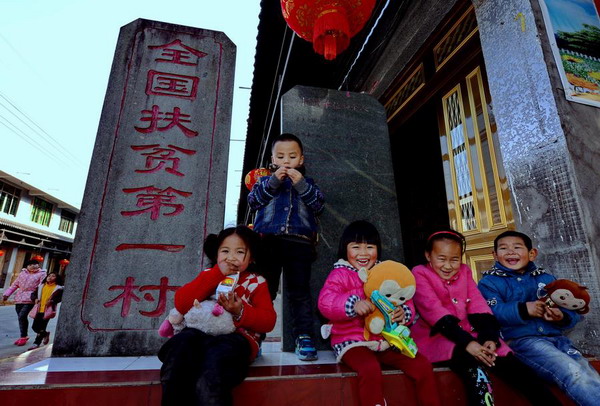
Children of Se ethnic group sit in front of a monument that reads "China's No. 1 Poverty Relief Village" at Chixi Village, Panxi town, Fuding city in East China’s Fujian province, Feb 14. The village has shaken off poverty thanks to assistance from Party and government officials at all levels over the past 30 years. [Photo/Xinhua] |
Size matters.
That is why the China factor counts so heavily in so many aspects of the present-day global economic picture. And why the size factor should never be ignored when appreciating the true picture of China.
The Global Wealth Report 2015, issued by the Credit Suisse Research Institute, is making headlines here, for such statements as China has taken Japan's place and become "the second richest" in terms of household wealth worldwide, and its claim that China's middle class is now larger than that in the United States.
The reliability of the conclusions aside, these assertions are all about size.
As with many other size-based calculations, the picture appears instantly different when our unrivalled population base factors in.
No matter how many millionaires we reportedly have, no matter how fast our middle class has reportedly expanded, and no matter how many luxury items Chinese tourists brought home from overseas trips, this country remains a developing country, where the average income remains low and the wealth gaps wide.
According to the same Credit Suisse report, the average Chinese household wealth is still roughly one-tenth of its Japanese counterpart.
That is precisely why a one-sided emphasis on the "big picture" can be dangerously deceiving.
But statements like these, which leave the crucial population factor out, tend to distract people from the actual wealth gaps that exist between regions as well as members of society.
Unlike eye-pleasing "big pictures", these gaps, if left unattended, may brew very real problems. Problems that promise to affect everyone, rich and poor.
That is why the recent central government proposal to incorporate the vast underdeveloped rural areas into the national e-commerce network is a smart one. Narrowing the "digital gap" between rural and urban areas will surely be conducive to handling the corresponding wealth gaps, because it can indeed bring out-of-the-way areas directly into the national market.
However, the country's official Gini coefficient, a gauge of economic inequality, has been hovering at a worryingly high level for years, slightly below 0.47 last year. Any figure beyond 0.4 is considered a warning sign.
Therefore the government's latest poverty-alleviation initiative, which aims to lift 70.2 million people above the country's own poverty line in six years, is an ambitious attempt to address the wealth gap for those at the bottom of society and should be realized with sustainable approaches.


Copyright 1995 - . All rights reserved. The content (including but not limited to text, photo, multimedia information, etc) published in this site belongs to China Daily Information Co (CDIC). Without written authorization from CDIC, such content shall not be republished or used in any form. Note: Browsers with 1024*768 or higher resolution are suggested for this site.
License for publishing multimedia online 0108263 Registration Number: 130349