 |
|
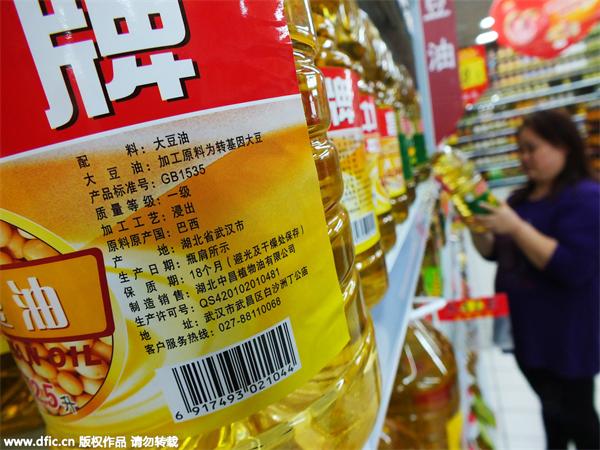
A kind of GMO cooking oil sold at a supermarket in Yichang, Hubei province. [Photo/IC] |
By 2050 there will be about one billion extra mouths to feed in Asia, as its population grows. We might be able to produce enough food; but how much of it will be safe to eat?
As we approach World Food Day on Oct 16, now is a good time to take stock of this challenge. There is a rising number of people who are sickened and killed by bad food, and correspondingly high public health bills. Bacteria, viruses, parasites, and chemicals in food can cause over 200 diseases, including cancer.
The World Health Organization says that as many as 700,000 children die of diarrhea each year in the Southeast Asia region, many of them after eating unsafe food. Disturbingly, 40 percent of all people sickened by food-borne illnesses are children.
Why is so much of our food unsafe to eat? Pressure to grow enough food for urban consumers is one factor. To meet demand, Asia's low-tech, labor-intensive farms are using more chemical fertilizers and pesticides, contaminating the soil and waterways with toxins such as lead and arsenic, which find their way into food. In South Asia - which has the region's largest number of malnourished children - around 43 percent of agricultural land is degraded, much of it due to inappropriate farming and processing practices, such as the unregulated use of chemicals, hormones and preservatives.
Another issue is the journey from farm to table. Farmers often live a long way - perhaps even in different countries - from city consumers. Asia's frequently humid weather compounds the problem. Poor storage, handling and transport logistics - many countries lack adequate cold-storage and transport facilities - mean half the vegetables produced in developing Asia spoil before reaching the market. Some of this rotten food is sold in the market and then eaten.
Meanwhile, unspoiled food may have had its shelf life extended by preservatives such as formaldehyde, also used as a medical disinfectant and an embalming agent. Climate change compounds the risks, as fluctuating temperatures make it harder to maintain quality along the production chain. Moreover, Asia now appears to be in the grip of El Ni?o, which could bring drought. This would threaten agriculture, which needs water for irrigation.
Fixing Asia's food safety problems won't be easy. But the good news is that measures to deliver enough food for Asia's millions would also lift the quality of their food.
To tackle food safety at source, greater efforts are needed to reduce environmental degradation, particularly of waterways and agricultural land. Asia's smallholder farms - 87 percent of the world's 500 million smallholdings - desperately need modernizing. Part of this is introducing enforceable regulations on the use of chemicals in pesticides and fertilizer. Farmers also need more support for climate adaptation measures including drought-resistant and salt-tolerant seed varieties.
Post-harvest, vast investments are needed to improve the storage and transport of food at each stage of the production chain. Investment by both public and private sectors in infrastructure such as storage and cold chains will lift safety standards and help millions of smallholders find dependable markets for their produce.
This could spur the creation of well-organized wholesale markets - such as Frischezentrum in Frankfurt, Rungis in Paris and Mercasa in Madrid - which provide safe and nutritious food for consumers through seamless linkages with millions of producers and suppliers.
Asia's increasingly complex production chains demand regional action to improve food safety. Countries in the Greater Mekong Subregion are addressing this by cooperating on better food handling and inspection systems. But more work is needed to harmonize food standards regionally, given the expanding cross-border trade in food. Governments should partner with private firms on certification systems for farms and retailers that provide safe food.
Private testing facilities can also play a role, as happens in developed markets such as Australia, Europe, and the United States where companies help the food industry achieve compliance with a range of safety standards. This typically does not happen in developing Asia where the priority is too often crop quantity rather than quality.
Consumers will pay a premium for safe food, so in the long-term everyone benefits. However, to achieve this win-win situation, we need to take action now.
The author is vice-president for knowledge management and sustainable development at the Asian Development Bank



I’ve lived in China for quite a considerable time including my graduate school years, travelled and worked in a few cities and still choose my destination taking into consideration the density of smog or PM2.5 particulate matter in the region.
Copyright 1995 - . All rights reserved. The content (including but not limited to text, photo, multimedia information, etc) published in this site belongs to China Daily Information Co (CDIC). Without written authorization from CDIC, such content shall not be republished or used in any form. Note: Browsers with 1024*768 or higher resolution are suggested for this site.
License for publishing multimedia online 0108263 Registration Number: 130349