 |
|
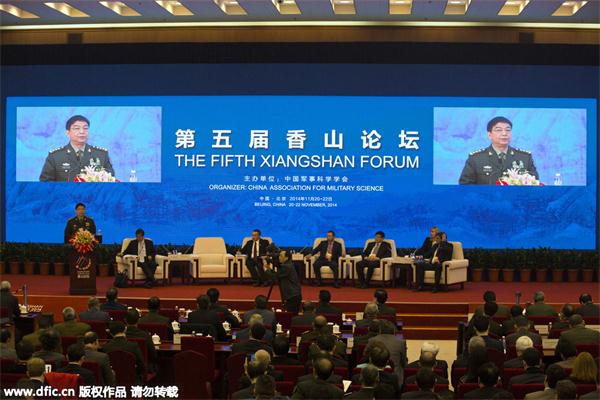
China's Defense Minister Chang Wanquan addresses the Xiangshan Forum, a gathering of the region's security officials in Beijing, China, Friday, Nov. 21, 2014. [Photo/IC] |
In 2014, with support of the Ministry of National Defense, the China Association for Military Science turned a forum for 30 scholars into one of the largest security forums in the Asia-Pacific. This year, around 60 official delegations and 130 scholars from around the world will gather in Beijing to attend the Sixth Xiangshan Forum from Oct 16-18. The Cambodian Prime Minister Hun Sen will deliver a key note speech at the inauguration dinner.
What does China, or more precisely the People's Liberation Army, want from such a forum? The first answer is: a louder voice. So far the PLA's humanitarian efforts such as counter-piracy, peace-keeping and disaster relief have been praised, but its efforts in safeguarding China's sovereignty and territorial integrity are often misinterpreted or even deliberately smeared. It is not rare to hear the PLA being described as "aggressive" or "assertive". Even the military parade to commemorate the victory in Chinese People's War of Resistance Against Japanese Aggression (1937-45) and the end of World War II was taken as a display of its muscles by Western media. This is unfair. Today even those most skeptical about China have to admit that China's rise has been peaceful.
The forum allows some of the best China specialists in the world to observe the PLA up close. China has recently decided to massively enlarge the number of troops it has on standby for UN peacekeeping missions and has said it will train more foreign peacekeepers. Is this a turning point that indicates the PLA will shoulder greater international responsibilities?
President Xi Jinping also recently announced a cut in 300,000 military personnel. This will be followed by one of the most fundamental restructurings in the history of the PLA after the founding of the People's Republic of China. How will the PLA carry this out?
Questions like these will be answered at the forum.
About 80 percent of global natural disasters occur in the Asia-Pacific, therefore humanitarian aid and disaster relief is always a hot issue. The chaos in the search efforts to find missing Malaysia Airlines flight MH370 demonstrates how badly an overarching multinational coordination center is needed in the region. The forum also has a special session on the ASEAN community building. The Association of Southeast Asian Nations has announced that it will establish such a community by the end of the year. Given the obvious political differences and economic disparities among the ASEAN member states, people may wonder how such a Cinderella-like change is going to realize the declared goals of economic and political security and socio-cultural integration. China is ASEAN's largest trading partner. It supports ASEAN's central role in the regional security architecture. How can both sides make sure the South China Sea issue does not dominate their relations, as they have agreed?
Security of sea lanes and a code of conduct in cyberspace are also on the table. Security of sea lanes is intrinsically associated with freedom of navigation, a fundamental principle in international law. As a major maritime trading nation, China firmly supports freedom of navigation. But China doesn't believe that the United States' military surveillance and reconnaissance in China's exclusive economic zone is freedom of navigation. Nor does China believe, as the US has claimed, that its land reclamation in the South China Sea interferes with freedom of navigation. Meanwhile, the two countries agreed during Xi's visit to Washington that neither country's government will conduct or knowingly support cyber-enabled theft of intellectual property. This is a major step forward from pointing fingers at each other. What next? A discussion on a code of conduct among all stakeholders could not be more appropriate or needed. The fact is, so far, no official rules have been formulated to guide international cybersecurity policy.
Mid-October is most beautiful in Beijing. The maple leaves start to turn red in Xiangshan Mountain and the yellow gingko leaves add a warm hue to the tree-lined streets. The atmosphere cannot be more agreeable for a forum.
Welcome to Beijing.
The author is an honorary fellow with Center of China-American Defense Relations at the Academy of Military Science.



I’ve lived in China for quite a considerable time including my graduate school years, travelled and worked in a few cities and still choose my destination taking into consideration the density of smog or PM2.5 particulate matter in the region.
Copyright 1995 - . All rights reserved. The content (including but not limited to text, photo, multimedia information, etc) published in this site belongs to China Daily Information Co (CDIC). Without written authorization from CDIC, such content shall not be republished or used in any form. Note: Browsers with 1024*768 or higher resolution are suggested for this site.
License for publishing multimedia online 0108263 Registration Number: 130349