 |
|
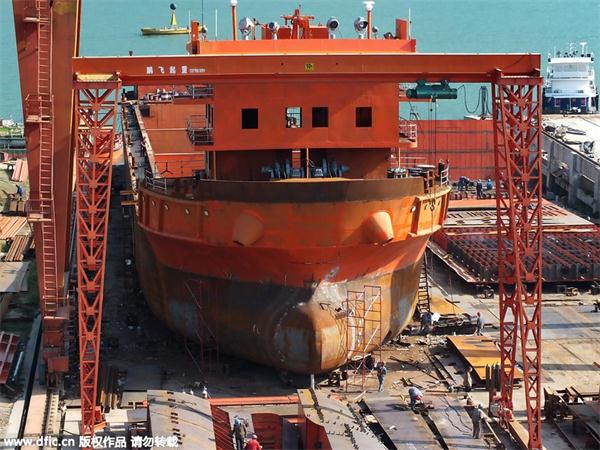
A cargo ship is being built at a private shipyard on the bank of the Yangtze River in Yichang, central China's Hubei province, April 13, 2015. [Photo / IC] |
With the bursting of the Chinese stock market bubble in July and the slight but unexpected depreciation of the renminbi, by about 4 percent in August, the world markets have panicked and doomsayers are coming out in droves to predict the imminent collapse of the Chinese economy. But the Chinese economy should be able to make a smooth transition to a "new normal", with an average annual growth rate of about 7 percent over the next few years, based once again on China's domestic demand.
The current "crisis" was a "crisis" of domestic and international confidence, caused by the slowdown of China's industrial sector and economic events such as the bursting of the stock market bubble and the attempted refinement of the foreign exchange trading mechanism.
Despite everything, it is unlikely that the Chinese economy will suffer a "hard landing", because the large and widespread excess production capacities in China's manufacturing industries will ensure aggregate supply so long as there is aggregate demand. Thus, the Chinese economy is not supply-constrained.
Given the excess manufacturing capacities in many industries and the excess supply of residential units in almost all except the very first-tier cities, private-sector fixed assets investment is not likely to be a robust source of increase for aggregate demand as it once used to be. Lowering the rate of interest alone is not going to induce additional private-sector fixed investment in either manufacturing or residential housing. Nor is export likely to be a source of increase of aggregate demand, given the relatively slow recovery of the US and European economies, the continuing rise in wages in China and the significant appreciation of the renminbi since 2005 (about 25 percent). The 4 percent depreciation of the renminbi in August was too small to have any significant impact.
Moreover, it is really not in the best interests of China to devalue the renminbi enough to go back to labor-intensive light manufacturing such as toy-making, with the low standard of living that such activities imply. It is far more important, from China's point of view, to continue the process of internationalizing the renminbi, so that it can be directly used for the invoicing, clearing and settlement of global transactions. For this purpose, the renminbi exchange rate vis-à-vis the US dollar must be kept at a stable level.
Chinese household consumption has been growing about 50 percent faster than real GDP during the past few years. But because of its low share in GDP, about 30 percent in 2014, it will not sufficiently boost aggregate demand to make a material difference as yet. Total final consumption, which includes both household consumption and government consumption, reached 60 percent of GDP in the first half of 2015. For household consumption to become a major driver of aggregate demand, real household disposable income must increase significantly faster than real GDP. Even then, it will take a while before household disposable income exceeds 50 percent of GDP.
Thus, in the short and medium terms, any significant growth in aggregate demand must come from investment in public infrastructure and commodity consumption. The government is expected to take the lead in both. Increasing investment in public infrastructure and commodity consumption to boost aggregate demand at this juncture has two additional advantages.
First, given the idle manufacturing capacities, the marginal social cost of investment in public infrastructure and commodity consumption is low. Second, the provision of public goods amounts to a redistribution of real income in kind, since, for example, both the rich and the poor breathe the same air and drink the same water. So, the move can reduce the degree of income disparity in China.
The author is a professor of economics at the Chinese University of Hong Kong.
Courtesy: China&US Focus



I’ve lived in China for quite a considerable time including my graduate school years, travelled and worked in a few cities and still choose my destination taking into consideration the density of smog or PM2.5 particulate matter in the region.
Copyright 1995 - . All rights reserved. The content (including but not limited to text, photo, multimedia information, etc) published in this site belongs to China Daily Information Co (CDIC). Without written authorization from CDIC, such content shall not be republished or used in any form. Note: Browsers with 1024*768 or higher resolution are suggested for this site.
License for publishing multimedia online 0108263 Registration Number: 130349