 |
|
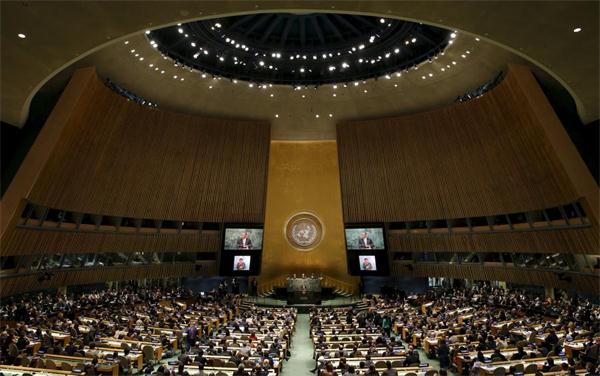
The United Nations Sustainable Development Summit 2015 at United Nations headquarters in Manhattan, New York, September 27, 2015. More than 150 world leaders are expected to attend the U.N. Sustainable Development Summit from September 25-27 at the United Nations in New York to formally adopt an ambitious new sustainable development agenda a press statement by the U.N. stated. [Photo/Agencies] |
A few decades ago, the population of the Asia-Pacific region was dominated by the young. Now, with the decline of birth rates, the population is aging. Twelve percent of the region is already over the age of 60.
By 2050, this figure is expected to rise to one-quarter of the whole population. Countries have never aged this rapidly. It took France 115 years and Sweden 85 years to become aged societies, but for Viet Nam and Thailand, it will take only 20 to 22 years. The region risks getting old before it get rich. So how do we address this crisis?
It’s clear the demographic window of opportunity for the region is closing. Take China for example: today, 67 percent of its population is of working age. But this has started to change. Forty years from now, this will have shrunk to only half, with almost one third of the entire Chinese population older than 65.
Does this mean that our region will inevitably lose its economic dynamism? Not necessarily. If we prepare properly, and act now, this can be avoided. The International Day of Older Persons, celebrated on October 1 every year provides us with a good opportunity to reflect on how to prepare for these new challenges.
There’s still ample scope to increase labor force participation, even as working-age populations decline. In many countries across the region, large proportions of the population, especially women, remain excluded from labor markets. For example in the Republic of Korea, only 56 per cent of working age women participates in the labor force. In South Asia, it’s less than a third. Going forward, countries will have to adopt more active policies to encourage and enable the participation of women in the labor force.
Countries with an increasingly aged population might also consider policies attracting orderly and reliable international migration as an additional option.
Another key element to be addressed is to increase productivity. The economic structure should move from labor-intensive industries to more technology-oriented ones. This entails improving the quality of education and promoting technological upgrades.
We need a new system of intergenerational solidarity. Traditionally, older people were looked after by their children. But traditional systems are breaking up as a result of increasing industrialization, increased women’s labor force participation and rural to urban migration. We can turn these changes into opportunities. We can turn aging population into a second demographic dividend, with financially-secure, healthy older persons, empowered to focus their decades of accumulated experience, wisdom and wealth to stimulate new economic growth.
The specific needs of older persons can also spur innovation and demand for new products creating job opportunities in care industries. This will only work if we act now. Currently, about 26 percent of working-age people in the region contribute to pension schemes. We need to develop the pension systems to increase savings and sustain domestic demand. We also need to introduce principles of solidarity into pension systems.
With the right preparation, we can benefit from a golden generation of healthy, wealthy and active older persons.
In 2002, the United Nations brought countries together in Madrid to agree on a global way forward: to treat older persons as actors of development; to ensure their health and wellbeing; and to create enabling and supportive environments for them.
In the new agenda for sustainable development adopted last week, older persons have a role to play in almost each of the new goals. The United Nations stands ready to support countries putting these plans into action securing future societies for all ages in Asia.
The author is an Under-Secretary-General of the United Nations and Executive Secretary of the Economic and Social Commission for Asia and the Pacific (ESCAP). She is also the UN’s Sherpa for the G20 and previously Served as Governor of the Central Bank of Pakistan and Vice President of the MENA Region of the World Bank.



I’ve lived in China for quite a considerable time including my graduate school years, travelled and worked in a few cities and still choose my destination taking into consideration the density of smog or PM2.5 particulate matter in the region.
Copyright 1995 - . All rights reserved. The content (including but not limited to text, photo, multimedia information, etc) published in this site belongs to China Daily Information Co (CDIC). Without written authorization from CDIC, such content shall not be republished or used in any form. Note: Browsers with 1024*768 or higher resolution are suggested for this site.
License for publishing multimedia online 0108263 Registration Number: 130349