 |
|
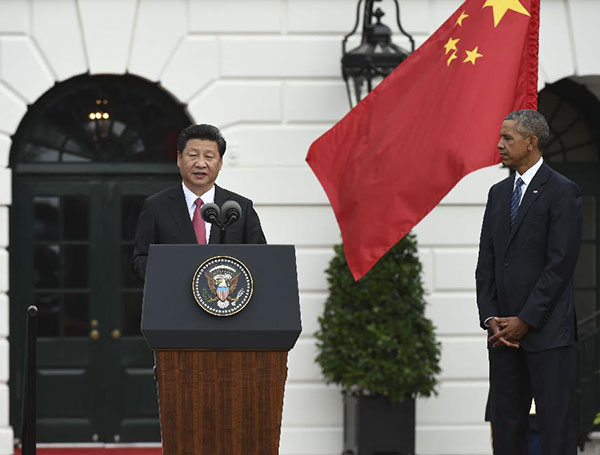
Chinese President Xi Jinping (L) addresses a welcome ceremony held by US President Barack Obama at the South Lawn of the White House in Washington DC, the United States, Sept 25, 2015. Xi arrived in Washington, the second stop of his state visit to the United States, on Thursday after a busy two-and-a-half-day stay in Seattle. [Photo/Xinhua] |
China's currency recalibrations have jolted global markets, as did America's 2013 "Taper Tantrum", when then-US Federal Reserve chairman Ben Bernanke said the fed might slow the rate of bond purchases. China is seeking inclusion of its currency in the International Monetary Fund's Special Drawing Rights not only to make renminbi global, but also to make it a world reserve currency. China has also set up the Asian Infrastructure Investment Bank (AIIB) and was key in putting together the BRICS development bank.
For some observers, this sets off alarm bells, and they are puzzled why the rest of the world isn't more concerned: "China's rise directly challenges America. Competition between the two is inevitable."
Such observers are not unique to one side or the other, but include both Chinese - Yan Xuetong - and American (John Mearsheimer) writers, and I paraphrase them, but only just.
Whatever idealists might suggest, a battle for world leadership is set and has been in works for a while.
Joseph Nye in his book Is the American Century Over? described how the "American century" emerged in the 1940s partly from its unique capacity to provide the global public goods the world needed. Nye masterfully showed us the devastating reach of his concept of soft power: That influence is more important than military power and that domination doesn't mean leadership. He reminded us how Singapore's Lee Kuan Yew had once told him that America would always be ahead of China: While China might boast a population of 1.3 billion people, America could draw on the talents and goodwill of more than seven billion.
But, in opposition to Nye's argument, that capacity to provide the world its global public goods is no longer unique to the US, nor is it obviously America's to wield. The world's economic center of gravity used to sit off the eastern seaboard of the US, but no longer. Many of the world's problems require global cooperation: No single nation by itself, certainly not the US, can take on the problem of global climate change, cybersecurity or international pandemics. That unique capacity that started the American century is no more. If the century is to remain American, the US will have to be a genuine leader, not just a unilateral doer.
America faces two options. It can lead the world by insisting it wields fearsome power - in its military, in its technology, in the strength of its economy, in its ownership of the world's reserve currency, in its creativity and in the Nobel prizes it wins.
Or it can lead the world by being a force for good.
 Media rekindle keenness in UK's China business

Copyright 1995 - . All rights reserved. The content (including but not limited to text, photo, multimedia information, etc) published in this site belongs to China Daily Information Co (CDIC). Without written authorization from CDIC, such content shall not be republished or used in any form. Note: Browsers with 1024*768 or higher resolution are suggested for this site.
License for publishing multimedia online 0108263 Registration Number: 130349