 |
|
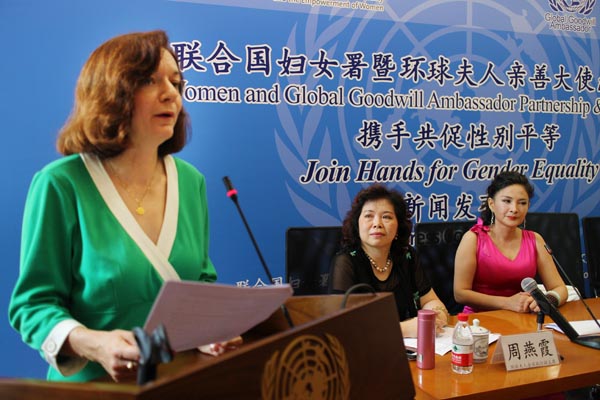
Julia Broussard, Country Programme Manager of the UN Women China Office, speaks at the announcement of the first gender equality fundraising event in China. [Photo by Zhang Yuchen/chinadaily.com.cn] |
In 100 countries around the world, women are barred from doing certain work solely because they are women. Over 150 countries have at least one law that is discriminatory towards women. And only 18 countries are free of any law disadvantaging women.
This is just the tip of the iceberg of legal barriers for women to achieve their full economic potential. New World Bank Group research in the Women, Business and the Law 2016 report shows that in 32 countries women cannot apply for passports in the same way as men and in 18 countries they cannot get a job if their husbands feel it is not in the family's interest.
Countries whose laws discriminate against women and do not promote gender equality suffer economically. Previous research tells us that gender gaps in women's entrepreneurship and labor force participation account for estimated income losses of 27 percent in the Middle East and North Africa, 19 percent in South Asia, 14 percent in Latin America and the Caribbean and 10 percent in Europe. These are losses that many countries can't afford, particularly those facing high levels of poverty.
There is good news too: Countries like Bangladesh are encouraging female participation in the workforce. If they stay on track, their female work force will grow from 34 to 82 percent over the next decade, adding 1.8 percentage points to their GDP. In the 1990s very few countries had laws protecting women from violence, now 127 do partially because the world is more aware of the human and economic cost of mistreating women.
When women are allowed to work in a profession of their choice, when they have access to financial services and when they are protected, by law, from domestic violence, they are not only economically empowered, they also live longer. The more say they have over the household income and the more they participate in the economy, the more girls are enrolled in secondary school, the larger the benefits for their children, their communities, and their countries. In fact, every additional year of primary school boosts girls' eventual wages by 10 to 20 percent, and an extra year of secondary school by 15 to 25 percent.
Critics will argue that in some countries where gender-specific laws exist, there is limited enforcement. While that is true, better rule of law is associated with having more gender equal laws on the books. Specialized courts that tackle cases of acts of violence against women can help provide effective legal action. In Brazil, the Maria da Penha Law allowed for the creation of domestic and family violence courts.
Other countries have also made important strides in addressing these issues. In India, inheritance law reform has provided greater economic freedom to women. Women used their increased savings to spend twice as much money on their daughters' education.
Lebanon adopted legislation on domestic violence, and increased the length of paid maternity leave from 49 to 70 days.
The private sector benefits too. A multinational survey of 6,500 firms showed that where women had greater representation on boards, those organizations were less likely to be hit by scandals like bribery or fraud. Yet surprisingly, only nine countries have laws where at least one woman has to be a board member of a publicly listed company.
The link between the fight against poverty and gender equality is strong. Which is why we work with many countries to tackle gender-based barriers.
Policymakers have a choice. They can use the overwhelming evidence that shows the economic benefits of equality by ridding their system of discriminating laws that are holding women back. Or they can maintain the status quo and condemn whole societies to remain poorer than they need to be.
The author is the Chief Operating Officer and Managing Director of the World Bank.



I’ve lived in China for quite a considerable time including my graduate school years, travelled and worked in a few cities and still choose my destination taking into consideration the density of smog or PM2.5 particulate matter in the region.
Copyright 1995 - . All rights reserved. The content (including but not limited to text, photo, multimedia information, etc) published in this site belongs to China Daily Information Co (CDIC). Without written authorization from CDIC, such content shall not be republished or used in any form. Note: Browsers with 1024*768 or higher resolution are suggested for this site.
License for publishing multimedia online 0108263 Registration Number: 130349