 |
|
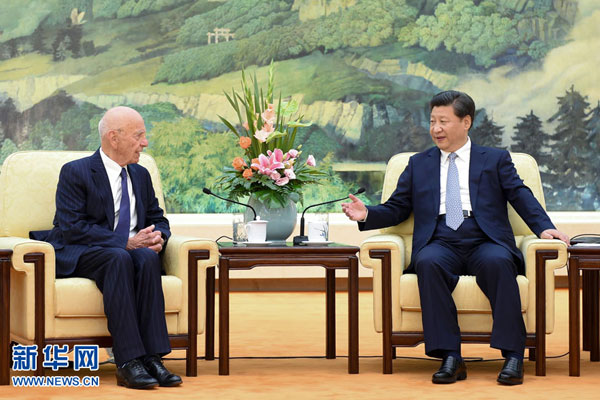
President Xi Jinping meets with Rupert Murdoch, executive chairman of News Corp. at the Great Hall of the People in Beijing, Sept 18, 2015.[Photo/Xinhua] |
As President Xi Jinping begins his weeklong state visit to the United States on Tuesday, many are wondering about the possible outcomes of the visit, which depend on the interactions between the two sides.
Former US Secretary of State Henry Kissinger, for one, suggested before Xi's visit that US President Barack Obama "talk honestly to the Chinese, to tell them what their concerns are, to learn Chinese concerns".
Given the increasingly delicate international situation and China-US relationship, how the two countries should control and manage their differences to deepen bilateral cooperation is expected to top the agenda of the Xi-Obama summit.
In Europe, the Ukrainian crisis has pushed the US and Russia to the brink of a new Cold War. The influx of refugees to Europe from the war-torn Middle East and the ongoing debt crisis in Greece are haunting the European Union. Besides, the expansion of the Islamic State in Syria and Iraq poses a grave threat to regional and even global stability.
In East Asia, China and Japan are yet to resolve their territorial dispute and other issues left over by history, and tensions escalated after the Japanese parliament passed new security bills a few days ago.
The US, as the world's sole superpower, has a slew of thorny domestic issues to deal with. Partisan clashes and social unrest, especially tensions between different ethnic groups, have dealt a blow to the country's global leadership. And the recent turbulence in the global stock and financial markets indicates that the world economy has not fully recovered from the 2008 global financial crisis, which swept across most emerging and advanced markets.
Admittedly, China and the US have managed to maintain extensive cooperation on various bilateral, regional and international issues thanks to frequent high-level dialogues, which included the 7th US-China Strategic and Economic Dialogue in June. But like some traditional major powers and emerging ones in the past, they face the "Thucydides trap" (in which the differences between an existing power and a rising one leads to war), which they have to avoid.
China replaced Japan as the world's second-largest economy in 2010. A year later, it overtook the US to become the world's largest manufacturer. On the other hand, diplomatic tensions have been rising as Washington pushes ahead with its "pivot to Asia" strategy to contain China's rise, dragging both sides into deeper trouble with regard to the East and South China sea issues. Also, their disagreements on cybersecurity, human rights and the end of the super-national treatment China extended to foreign investors have further complicated the China-US relationship, in which cooperation and competition co-exist, with the latter apparently on the rise.
Another worrying factor for China is the pessimism shown by China watchers, some of whom say the China-US "honeymoon" is coming to an end. Such remarks highlight the need for both governments to take measures to control and manage their differences, old and new, and this is exactly what Xi aims to do during his US visit. He will meet American citizens from all walks of life, as well as business elites and members of think tanks, and his meeting with Obama could see the two leaders having a candid conversation on major issues facing the two countries.
On behalf of the Chinese government, Xi is expected to float and expound a set of new ideas on optimizing the global order while participating in the General Debate of the UN General Assembly in New York. In all likelihood, his visit will end with new agreements and concrete deals on bilateral cooperation, convince Washington of Beijing's adherence to peaceful development, and create an objective image of China in US citizens' eyes.
Jin Canrong is deputy dean of the School of International Studies, Renmin University of China. Wang Hao is a doctoral candidate at the school.



I’ve lived in China for quite a considerable time including my graduate school years, travelled and worked in a few cities and still choose my destination taking into consideration the density of smog or PM2.5 particulate matter in the region.
Copyright 1995 - . All rights reserved. The content (including but not limited to text, photo, multimedia information, etc) published in this site belongs to China Daily Information Co (CDIC). Without written authorization from CDIC, such content shall not be republished or used in any form. Note: Browsers with 1024*768 or higher resolution are suggested for this site.
License for publishing multimedia online 0108263 Registration Number: 130349