In Hong Kong, where I worked in the late 1980s and early 1990s as a journalist, much was made by the United Nations High Commissioner for Refugees and government officials of the pull factor, which drove tens of thousands of Vietnamese to board rickety old boats and brave the waves and pirates infesting the South China Sea.
The pull factor is best defined as something that persuades people facing appalling hardships, oppression, war or simply economic disaster to take the most unimaginable risks to reach what they see as a haven of safety and hope.
For the Vietnamese boat people, about 2 million of them, the draw was the United States. That was the last huge diaspora, until now.
The conflict in Syria and Iraq, and to a lesser extent Afghanistan, has generated tens of thousands of refugees, a situation that suddenly became acute in the summer as families fled the bloody civil war that has engulfed the two countries.
And here's where the pull factor kicks in.
Most of the migrants, interviewed on television, say their stated aim is a new life in Germany. It seems that desire was prompted in part by conversations they have had with relatives who are already established there, studying and working.
Germany's birth rate is dropping, and to boost its already robust economy, it needs fresh migrants, which is probably what prompted Chancellor Angela Merkel to say that her country would welcome refugees from Syria and Iraq, her message going out as German officials estimated they could receive as many as 800,000 applications for asylum this year.
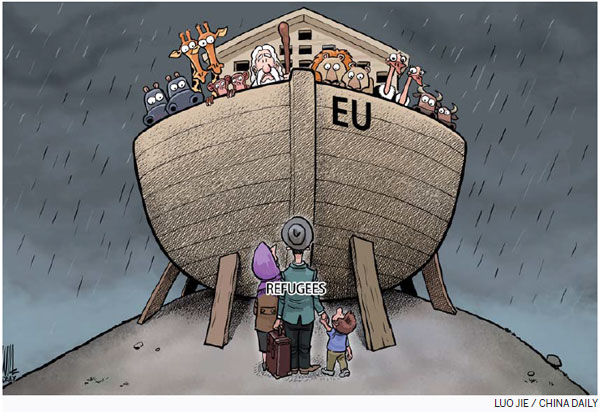
The route to Germany from Syria and Iraq is fraught with danger - would be migrants have to get through Turkey, then, at the mercy of people traffickers, take unstable rubber dinghies across the Aegean Sea to Greece, their first port of call in the European Union.
Finally, exhausted after walking, bussing and train journeys - if they're lucky - they cross through Macedonia, Serbia and Hungary before heading across Austria by train to the German city of Munich, where, they hope, salvation awaits.
But it's all gone horribly wrong. Hungary's right wing government decided it was fed up with tens of thousands of people, unchecked, crossing its territory. On Sept 15, at midnight, the gates slammed shut - literally. A 100 mile-long steel fence, topped by razor wire, stopped the refugees in their tracks. Hungary said only those with correct papers could pass through checkpoints manned by the army and police. The stand-off continues.
Austria, too, said it was temporarily halting trains to Germany. And in a final volte-face, Merkel temporarily imposed strict border controls as officials in Munich said they were facing a humanitarian crisis as they struggled to cope with the influx.
On Sept 12 alone, 13,000 arrived in Munich, overwhelming the officials and charities that have been helping them.
So what to do? Finally, the EU has started discussing ways of tackling the crisis at ministerial level. There is much talk of a quota system, but eastern European members of the EU say they aren't interested.
Many officials and politicians feel that Merkel's offer to take refugees wasn't thought through properly. Don't forget there are an estimated 3 million Syrian refugees in Jordan, Turkey, Lebanon and Iraq, sitting in camps. They at least can be processed by UNHCR and other agencies, but it's a slow process.
Those who have been dealing with refugees for years say it would have been far better for Merkel to have set up some kind of rudimentary screening process at the border of the EU and struck agreements with countries through which the refugees pass before making her announcement.
And here's the difference between the Vietnamese boat people and the present crisis. Despite the hardships they faced, the country they came from was a viable, albeit poor, entity. The UNHCR was able to implement resettlement programs and also negotiate a Voluntary Return scheme, under which boat people who agreed to return home would not be prosecuted by Hanoi, and they were give resettlement grants, and the whole process was monitored. By the time China regained sovereignty over Hong Kong, the camps were cleared.
Syria and Iraq pose a different problem - Syria's towns and cities are devastated, the government controls less than 30 percent of the country, and ISIS and other rebel groups roam free. There is no one to negotiate with. There will be no going home for many years.
Europe has a major headache.
The author is managing editor of China Daily Europe, based in London. Contact the writer at chris@mail.chinadailyuk.com


Copyright 1995 - . All rights reserved. The content (including but not limited to text, photo, multimedia information, etc) published in this site belongs to China Daily Information Co (CDIC). Without written authorization from CDIC, such content shall not be republished or used in any form. Note: Browsers with 1024*768 or higher resolution are suggested for this site.
License for publishing multimedia online 0108263 Registration Number: 130349