 |
|
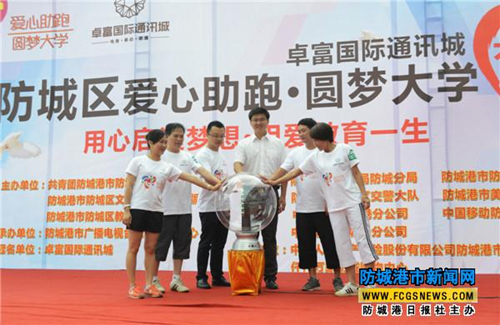
Fangcheng district government officials launch the running activity organized to help impoverished students attend university education. [Photo/Agencies] |
Huang Hongbin, chairman of a charity philanthropic foundation and headmaster of a charity primary school in Liangshan Yi ethnic autonomous prefecture, Southwest China's Sichuan province, was detained by police early last week for suspected illegal transfer of State-owned forest land, illegal construction and financial wrongdoings in the foundation.
Late last month, Wang Jie, a private charity website operator claiming to collect donations for poor students in Baise (mostly in Longlin county), South China's Guangxi Zhuang autonomous region, was arrested for sexually abusing a number of female students.
Huang's school had been operating for more than three years, and won praise even from the local government, and Wang was a nightmare to girls of poor families for nine years, until a donor found out the truth.
The two cases have turned two self-proclaimed philanthropists into criminal suspects, raising questions such as: How to tackle evil in the garb of good? How could Huang and Wang use charity as a shield to make money and satisfy their lust without being detected for such a long time? And how many such fake philanthropists are still out there?
The local governments of Liangshan and Baise claim to have learned painful lessons from the two cases, and have promised to keep a closer watch over such philanthropists. But more is needed.
The investigation and trial of the two suspects should be transparent and the authorities must clear people's doubts that some civil servants had been shielding Huang and Wang for personal gains.
Thorough investigations in the two cases should not be aimed at clamping down on private charities, which are regarded by many as competitors to State-owned charity agencies. Instead, the investigations should help identify better ways to regulate and promote the healthy development of private charities.
The government, over the past three years, has simplified the procedure of setting up private charity organizations and made it easier for them to register with the civil departments. In fact, it regards opening up the charity sector to private players as a progressive reform, in which the government intervenes as little as possible and lets the market and society play bigger roles.
But that does not mean the government should sit idle, especially when the legal system regulating private charities is not fully developed.
Donations to private charities should be transparent and made through legal channels. Auditing and other government departments must strictly scrutinize the use of funds to prevent people like Huang and Wang from misusing them for personal gains.
Baise and Liangshan both are poor areas, where many people still earn less than $1 a day. But the two places are rich in resources, in non-ferrous metals like aluminum in particular, and forest products, which are the envy of the more developed but resource-scarce coastal regions. Given these facts, the local governments have to ensure that charities there really help the people, instead of exploiting them or the resources in the areas.
Also, the authorities have to spread awareness about the charity organizations. For example, every donor has the right to know how his/her money is spent and who the beneficiaries are. Had not a donor from Tai'an, Shandong province, visited the children she helped through Wang in the Baise mountains, the impostor would have continued with his evil deeds.
More importantly, local governments should not neglect their duty to provide nine-year compulsory education to children, especially in areas fighting poverty.
In Liangshan, the local government relied heavily on Huang's school, because before it was opened most of the about 200 students had to trek the arduous mountain paths for five hours to and from school. Therefore, the provincial governments in Sichuan and Guangxi should increase their education budgets to ensure places like Liangshan and Baise are not left behind in development. Higher spending on education should not be a burden on any government, because it will be worth every penny in the future.
The author is a writer with China Daily. liyang@chinadaily.com.cn



I’ve lived in China for quite a considerable time including my graduate school years, travelled and worked in a few cities and still choose my destination taking into consideration the density of smog or PM2.5 particulate matter in the region.
Copyright 1995 - . All rights reserved. The content (including but not limited to text, photo, multimedia information, etc) published in this site belongs to China Daily Information Co (CDIC). Without written authorization from CDIC, such content shall not be republished or used in any form. Note: Browsers with 1024*768 or higher resolution are suggested for this site.
License for publishing multimedia online 0108263 Registration Number: 130349