 |
|
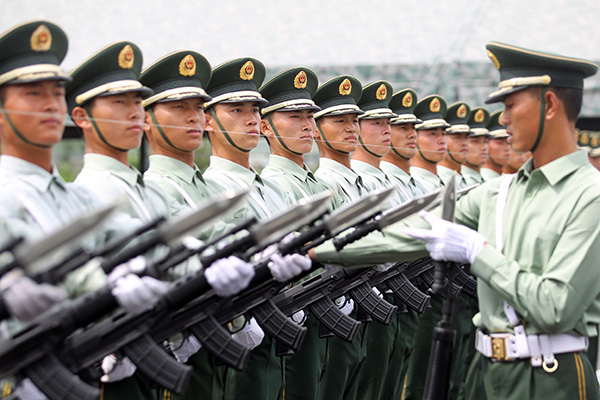
Soldiers of a marching unit look on during a training session ahead of the Sept 3 military parade to mark the 70th anniversary of the victory in the War of Resistance against Japanese Aggression. [Photo/China Daily] |
China is commemorating the 70th anniversary of the victory in the War of Resistance Against Japanese Aggression (1937-45) and World War II. The climax of the celebrations will be a military parade on Sept 3. The parade is unusual as it departs from the past practice - of holding one parade a decade on National Day - but it will highlight the cruelties of war, and the suffering of the Chinese people and their heroic resistance to Japanese aggression seven decades ago.
Unfortunately, some Western politicians and media outlets have been skeptical of the commemoration. In particular, the leaders of some countries that were part of the Allied Forces in WWII have appeared indecisive over whether or not to attend the commemorative events. Their response can be attributed to their worries over the potential impact of China's development on the political and economic spectrum of the world.
These worries also stem from Russia's alleged role in the Ukraine crisis. Some Western politicians and observers assume China and Russia are forging an anti-West front even though the two countries don't have any alliance. Besides, the maritime disputes in the East China and South China seas have also caused some misunderstandings in the international community.
In addition, the Chinese military's efforts to upgrade its air force and navy in order protect the country's expanding shipping lanes and fulfill international obligations have touched some countries' sensitive nerves.
But the truth is, these countries' have taken such a stance because the United States wants to contain China, the European Union is non-committal, and some countries in Southeast Asia fear or are suspicious of China's rise.
The West's indifference to China's commemorative activities is a policy blunder that should have been avoided. Few Westerners truly understand how important the war 70 years ago was in changing Chinese people's opinion about the outside world. From the First Opium War in 1840 to the breaking out of the Pacific War in 1941, the overall Chinese attitude to Western countries could be summarized in one word: "aversion". And there were many reasons for that.
Westerners' condescending attitude toward Chinese, their naked attempt to expand their colonies, the tremendous cultural differences between China and the West, and China's stubborn resistance to world trade all contributed to the contradictions between the two sides. The Boxer Rebellion (1899-1901) and the Eight-Nation Alliance against China were the high points of such conflicts. As a result, "Western devils" had become the average Chinese way of referring to Westerners.
It was the brutal Japanese aggression that claimed the lives of millions of Chinese and threatened the very existence of China as a nation which made the majority of Chinese see the positive side of the outside world. Seeing the helping hands of the US, Great Britain and the Soviet Union, the Chinese people realized that their country and the majority of the other countries have much to share. The victory in the war against fascism helped build friendship and trust between China and the US and European countries, as well as facilitated China's participation in the creation of the United Nations.
After the founding of the People's Republic of China, and despite such historical detours as the Korean War (1950-53), it was common understanding of the postwar world order that eventually helped New China to gain its rightful seat in the UN. And China became an important part of the world after Deng Xiaoping launched the reform and opening-up in the late 1970s.
Therefore, it is difficult to understand why Western countries have decided to stay away from the commemoration activities in China and, in the process, are missing on a wonderful opportunity to review the common understanding. The shoulder-to-shoulder fight with the Allied Forces that resulted in the victory in WWII taught the Chinese that humanity could not have taken any of its significant strides on the strength of one country alone. In the same way, real peace and prosperity cannot be achieved without a "global community of shared destiny".
And since the Chinese leadership under President Xi Jinping has chosen the path toward a "global community of shared destiny", Western worries over the parade are not only unnecessary, but also ridiculous.
The author is a research scholar at the China Foundation for International and Strategic Studies.
Courtesy: chinausfocus.com



I’ve lived in China for quite a considerable time including my graduate school years, travelled and worked in a few cities and still choose my destination taking into consideration the density of smog or PM2.5 particulate matter in the region.
Copyright 1995 - . All rights reserved. The content (including but not limited to text, photo, multimedia information, etc) published in this site belongs to China Daily Information Co (CDIC). Without written authorization from CDIC, such content shall not be republished or used in any form. Note: Browsers with 1024*768 or higher resolution are suggested for this site.
License for publishing multimedia online 0108263 Registration Number: 130349