 |
|
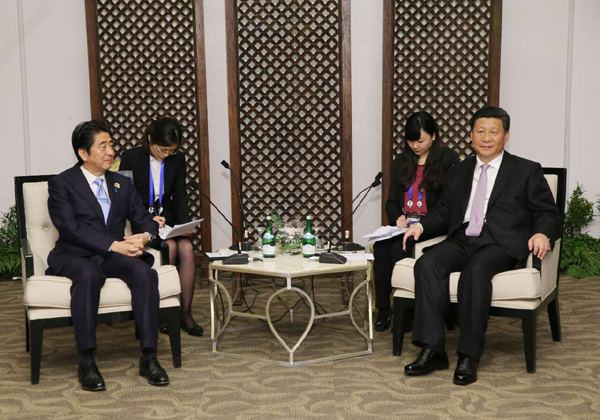
Chinese President Xi Jinping (R) and Japanese Prime Minister Shinzo Abe hold a meeting at the request of the Japanese side in Jakarta, Indonesia, April 22, 2015.[Photo/Xinhua] |
With China preparing to mark the 70th anniversary of the end of World War II, it is time to reflect on the past and take measures to fortify a peaceful future. The anniversary is especially important for China because it not only bore the brunt of Japanese aggression before and during WWII, but also played a key role in Japan's defeat.
Thanks to the lessons of WWII, the international community has succeeded in avoiding another world war despite regional conflicts and tensions, with the United Nations and its principle of non-aggression and coordination among major powers laying the foundation for world peace.
The United States' role both during and after WWII has been unique. During WWII (in 1941 to be precise), the US forged a strategic partnership with China and the two countries jointly fought against Japan. After Japan's surrender in WWII, the US made the country adopt a pacifist Constitution, which stipulated Japan should not have a full-fledged military and could take defensive action within its territory only. According to the Constitution, therefore, Japan is not entitled to "collective self-defense" despite its alliance with the US.
Over time, the US has turned its former enemy into an ally. Although such reconciliation is welcome and it is commendable that Washington and Tokyo have been able to heal their wounds, it seems the US made Japan an ally primarily for geostrategic purposes during the Cold War - to use Japan for regional and global dominance. Consequently, the US has ignored not only the spread of rightwing ideologies in Japan but also its leaders' refusal to express remorse for the country's war past. In fact, the US has rewarded Japan for its actions and inactions both, by "handing over" the Diaoyu Islands to it in 1972 and by defending Japan's "sovereignty" over them.
Unlike in Europe where Germany's apology for its war past has led to total rapprochement, the reconciliation among countries in Asia over WWII is incomplete, mainly because of Japanese politicians' refusal to own up to Japan's past. To be honest, some Japanese politicians have "apologized" for their country's military past, but a majority of them have provoked other Asian countries by denying Japan did anything wrong before and during WWII. Japanese officials' reluctance to express remorse for and desperate bid to disown their country's past have prevented true reconciliation between Japan and its WWII victim countries, including China.
China has always believed in giving the past a decent burial, and employed a "looking forward" approach four decades ago to normalize relations with Japan. Also, China shares the view that "Japanese people too were the victims of Japan's imperialist aggression". But Japan's rightwing politicians have often rebuffed China's approach. As a result Japan's relations with China, the Democratic People's Republic of Korea and the Republic of Korea have become increasingly unstable.
In this regard, the US is again in a unique position, because it can be a bridge to reconciliation between China, its WWII ally, and Japan, its present ally. Sure, the US is worried about China's rise, but that is no excuse for it to turn a blind eye to Japan's provocative acts.
The activities China has planned to observe the 70th anniversary of the victory in the fight against fascism offer a new opportunity to review the past and turn a new leaf in history. By inviting American and Japanese leaders to attend the activities, China sent a message that it is ready to jointly set the past right and work in collaboration in the future. If the US leadership is indeed farsighted, it should not fail to capitalize on such an opportunity to bridge the divide between China and Japan.
The author is a professor at and associate dean of the Institute of International Studies in Fudan University, Shanghai.



I’ve lived in China for quite a considerable time including my graduate school years, travelled and worked in a few cities and still choose my destination taking into consideration the density of smog or PM2.5 particulate matter in the region.
Copyright 1995 - . All rights reserved. The content (including but not limited to text, photo, multimedia information, etc) published in this site belongs to China Daily Information Co (CDIC). Without written authorization from CDIC, such content shall not be republished or used in any form. Note: Browsers with 1024*768 or higher resolution are suggested for this site.
License for publishing multimedia online 0108263 Registration Number: 130349