 |
|
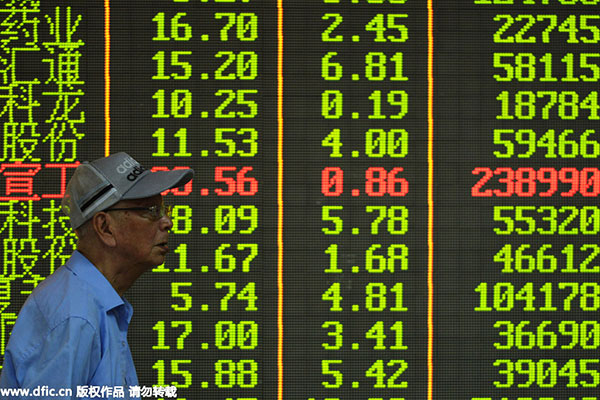
A Chinese investor walks past a screen displaying prices of shares at a stock brokerage house in Hangzhou city, East China's Zhejiang province, August 20, 2015. [Photo/IC] |
China's Shanghai Composite experienced a Black Monday as share prices fell over 8% and other major stock markets had a dark mood in response. Chinese stocks continued their fall the next day, recording a Black Tuesday of almost another 8%, a frightening double dip, even as other markets saw some respite. The reaction in the major economies is not because overseas stock investors have lost money in China - Capital Economics, a London consultancy, estimates that only 2% of shares are owned by foreigners. Equally, most Chinese have not lost money in this market crash, as only one in 30 Chinese own any stocks (Capital Economics again). Indeed those who did buy stocks last year and have held on to them could still be showing a paper gain, though now clawed back to around a third of the 150% once posted.
The local pain is felt by a relatively small percentage of the population but still a large number of many millions who piled in the first half of this year and then saw losses. Those small retail investors, often using borrowed funds, did not have the confidence to ride out paper losses by leaving the shares alone - they probably needed to repay and cut losses. Of course bigger investors could not sell if they held 5% or more of the shares in a company. Before Monday, it was estimated that over 20 million small investors had quit the market. That number has now surely risen, as retail investors fled the market this week. They will be hurting and household spending is likely to be hit by what economists call a wealth effect: income may not have changed but having higher valued assets - stocks and property - encourages more spending. Now we will see the reverse as confidence has been hit.
In the overseas exchanges, investors are reacting more to the implied bad news about the Chinese economy's future growth prospects - the continuing fall in the Purchasing Managers' Index month after month, the assumption that the devaluation of the renminbi (RMB) was a desperate move to stimulate falling exports and the fear that the authorities are struggling to rebalance the economy away from unproductive investment projects and towards household consumption. There is recognition that growth targets may no longer be hit and the Chinese GDP may not achieve 7% this year. That slowing growth does hit western economies through reduced imports by China and less domestic demand for local production (and hence lower profits) of Western companies operating in China.
However, again confidence is a key factor. During the 30 plus years of China's near double digit annual economic growth rates, the conventional wisdom was that 8% growth was necessary to maintain employment growth and social stability. Actual rates usually exceeded this and that gave confidence in the Chinese authorities' economic management. When targets were reset in the past couple of years of the new normal, 7% was the goal. I wrote at the time that perhaps 6% should have become the new 8, because it focuses expectations more on quality growth and was a more realistic target. At a 10% annual growth rate, an economy doubles in size every seven years. What 6 % represents in extra goods and services now is much more than what 8 % represented a decade ago. If markets had been long expecting 6% this year, the prospect of 6.5 % would be confidence boosting. Instead, almost too much by coincidence, we are told the economy just made the 7% and signs of under shooting abound for the rest of the year. Thus a crisis of confidence arises.
To encourage banks to lend more and bring some liquidity to the markets and the economy, the central bank, People’s Bank of China(PBOC) lowered interest rates 25 basis points from Wednesday (the fifth cut since last November)and from September there will be another cut in the Reserve Ratio Requirement (cash held by banks). This is another measure trying to underpin the growth rate target more than to impact the Chinese stock market. It is unlikely to restore confidence in stocks but the stock market is not a direct reflection of the state of the Chinese economy.
The yuan devaluation should not be blamed for the global events. We cannot ignore the steady rise in the US dollar against most currencies and by default, while the RMB is kept within a narrow band against the dollar, the rise in the value of the RMB against other currencies too.
Good export demand is important for China until household expenditures can grow significantly and this is a slow adjustment process. The yuan had become a one-way bet - it could only appreciate. Now the authorities have changed that perception and allowed more market reflection - the IMF seems broadly supportive.
Western economies cannot have it both ways - they worry about declining Chinese GDP, yet they worry about a yuan devaluation that could boost that GDP. Surely the West would just love some more imports of consumer goods at cheaper prices from China?
The author is an economist and director of China programs at?CAPA, The Global Education Network, a US-UK-based organization that cooperates with Capital Normal University and East China Normal University.


Copyright 1995 - . All rights reserved. The content (including but not limited to text, photo, multimedia information, etc) published in this site belongs to China Daily Information Co (CDIC). Without written authorization from CDIC, such content shall not be republished or used in any form. Note: Browsers with 1024*768 or higher resolution are suggested for this site.
License for publishing multimedia online 0108263 Registration Number: 130349