 |
|
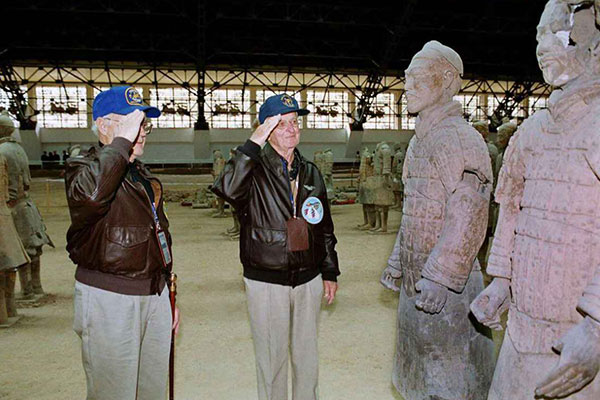
Paul Krof (left) and Mark Mcdonnell, the two Flying Tigers' pilots. |
China's decision to hold a military parade on Sept 3 to commemorate the 70th anniversary of the end of World War II is causing the United States a headache. But the Barack Obama administration needs to show courage to send a high-level official delegation to attend the event even at the risk of offending Japan. More importantly, the US should remind itself of its historical role in healing the wartime animosity between China and Japan at a time when relations between them are strained.
The dilemma for the US, however, is not simple. True, China was the US' main Asian war ally, and millions of Chinese fought alongside American GIs in the China-Burma-India theater of war to stop the Japanese from conquering the entire Asia-Pacific region. And millions of Chinese fell to Japanese aggression during the Chinese War of Resistance Against Japanese Aggression (1937-45).
But much has changed over the past seven decades. From a militaristic autocracy Japan became a pacifist democracy and a close strategic ally of the US, which still has about 100,000 military personnel and their family members in Japan. As the US' third-largest trading partner and top debt holder, Japan is very important for the US economy. In contrast, China-US relations have more or less moved in the opposite direction. For almost the rest of the 20th century after WWII, China was barely relevant on the world stage before re-emerging as a major economic and military power, which many see as a US adversary in the making.
What makes US participation in the parade particularly sensitive is Japan's unwillingness to own up to its war past. Japanese leaders have expressed regret for the atrocities committed by the Japanese Imperial Army during WWII, but they are yet to issue a formal and sincere apology to the Chinese. As a result, Chinese people's grievances against Japan still influence China-Japan relations and, if untreated, bilateral ties could worsen.
But even if US leaders decide not to attend the parade, they should not ignore the war anniversary altogether. Such an action would not only be historical injustice to the longest theater of WWII, but also be an affront to the families of the 100,000 Americans who lost their lives in the Pacific, and for the remaining war veterans for whom this might be the last big anniversary.
Perhaps the US could use the occasion - given its unique position as erstwhile ally of China and present-day ally of Japan - to promote Sino-Japanese reconciliation. And US President Barack Obama should take advantage of President Xi Jinping's first state visit to Washington, just two weeks after the parade in Beijing, to mark the anniversary. It can be done at a memorial ceremony or a cultural event, perhaps at the National World War II Memorial not far from the White House, in the presence of war veterans from both countries, in order to avoid poking Japan in the eye. Obama could use the event to also urge China and Japan to do a better job of dressing up the wounds of the war in order to once and for all clear this diplomatic blister from the Asia-Pacific.
Maintaining stability in East Asia is one of America's highest foreign policy priorities. At the very least, the US must do its utmost to ensure that the ghosts of WWII are no longer at their disposal.
The author is co-director of the Institute for the Analysis of Global Security and senior adviser to the United States Energy Security Council.
Courtesy: chinaus focus.com



I’ve lived in China for quite a considerable time including my graduate school years, travelled and worked in a few cities and still choose my destination taking into consideration the density of smog or PM2.5 particulate matter in the region.
Copyright 1995 - . All rights reserved. The content (including but not limited to text, photo, multimedia information, etc) published in this site belongs to China Daily Information Co (CDIC). Without written authorization from CDIC, such content shall not be republished or used in any form. Note: Browsers with 1024*768 or higher resolution are suggested for this site.
License for publishing multimedia online 0108263 Registration Number: 130349