 |
|
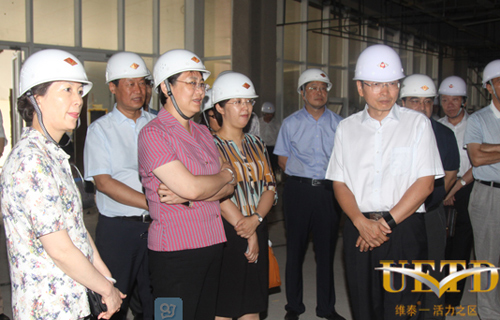
A delegation from Xinjiang Cultural Department visits Economic and Technological Development Zone in Urumqi city, Xinjiang, Aug 10. [Photo/Agencies] |
The Xinjiang Uygur autonomous region covers one-sixth of China's land area and one-fourth of its land border. Six decades of fast-paced development have transformed Xinjiang into an important window of the country's opening-up, and an indispensable strategic and protective shield in western China.
President Xi Jinping proposed the "Belt and Road Initiative" in 2013 that connects the past with the present, as well as China with the rest of the world. The initiative is not only in line with the development trend of modern times, but also welcomed by countries along the belt and road. The main goal of the initiative is to promote common development and communication among different countries and regions.
Xinjiang is entering a new phase of development, and the central government attaches great importance to its role in deepening the country's communication and cooperation with Central Asia, South Asia and West Asia, as well as Europe and Africa. The region also has the potential to become an important transport hub on the China-proposed Silk Road Economic Belt.
The Xinjiang Development Forum, an important platform for international communication, can help spread the spirit of the ancient Silk Road among future generations, make the international community aware of Xinjiang's true development potential, and thus push forward the initiative. But for that, three things are necessary.
First, the forum should serve as a window for the world to know the new and fast-developing Xinjiang. The past 60 years have seen Xinjiang transform from a backward inland region to a prosperous, united, safe and harmonious home to different ethnic and religious groups - people's livelihoods have been continuously improving through their own efforts and the central government's help.
Under the regional ethnic autonomy system of China, Xinjiang already has the basic conditions to become a core zone of the Silk Road Economic Belt, and it boasts of social and economic structures to make the opening-up policy a success.
Xinjiang has an autonomous system, from the township to provincial level, making it a model autonomous region in China. Since it is always better to see for oneself than to hear from others about the real conditions, distinguished guests at the forum (the Xinjiang Development Forum held in Urumqi on Tuesday) must have arrived at a more objective conclusion after their inspection tour of the region. I hope the distinguished guests will let the international community know the real and harmonious development in Xinjiang.
Second, the forum should serve as a platform for cooperation and cultural exchanges. Xinjiang's cultural milieu is unique in its diversity, perhaps because it served as an important bridge between the East and the West. And in modern times, we can coexist peacefully only if countries recognize diversity, respect cultural differences and share each other's concerns.
And third, Xinjiang needs to deepen its cultural and educational exchanges with the outside world, for example, through cultural and people-to-people contacts, which are at the core of the Silk Road spirit.
Xinjiang and the countries that border it have many things in common, which can form a solid foundation for the building of the Silk Road Economic Belt. But for this, the region needs to promote communication and cooperation between Chinese and foreign think tanks.
After upgrading the "Belt and Road Initiative" to a national strategy, the Chinese government worked out an action plan to implement it. And the establishment of the Silk Road Fund and the Asian Infrastructure Investment Bank is proof that China is committed to strengthening policy communication and transnational transport, trade, finance and people-to-people exchanges. The forum should help realize these goals.
The author is the deputy director of the State Council Information Office of China. The article is an abridged version of her speech at the opening ceremony of Xinjiang Development Forum in Urumqi on Tuesday.



I’ve lived in China for quite a considerable time including my graduate school years, travelled and worked in a few cities and still choose my destination taking into consideration the density of smog or PM2.5 particulate matter in the region.
Copyright 1995 - . All rights reserved. The content (including but not limited to text, photo, multimedia information, etc) published in this site belongs to China Daily Information Co (CDIC). Without written authorization from CDIC, such content shall not be republished or used in any form. Note: Browsers with 1024*768 or higher resolution are suggested for this site.
License for publishing multimedia online 0108263 Registration Number: 130349