 |
|
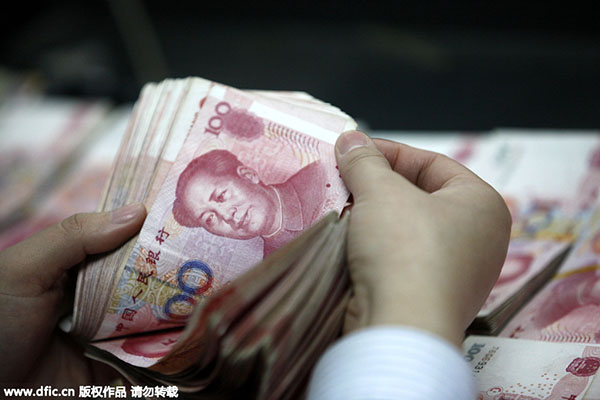
A Chinese clerk counts RMB (renminbi) yuan banknotes at a bank in Huaibei city, East China's Anhui province, January 22, 2015. [Photo/IC] |
On Aug 11, 2015, the People's Bank of China lowered the yuan's exchange rate by almost 2 percent. The central bank's move pushed the yuan's "daily fix" to 6.2298 against the US dollar. This move was its biggest one-day change for the yuan since China had loosened (somewhat) its dollar peg in June 2010.
The yuan halted a three-day slide after the central bank soothed market sentiments on Thursday, reversing short but sharp declines triggered by a foreign exchange policy change.
The developments immediately made financial market observers jump to two "conclusions": First, while the central bank, in its announcement of the move, paid lip service to a more flexible exchange rate regime, its action really signaled panic over China's slowing growth. And second, this devaluation was not a one-time shot, but rather the likely start to a prolonged period of engineering the yuan downward in a resolute effort to increase China's external competitiveness.
As news of the devaluation spread, all China-sensitive asset prices - such as oil, copper, shares of luxury brands and cars, and emerging-market currencies - dove below their already depressed levels.
While the markets' reaction reflected a lot of "first world" frustration, look at the latest development in China from a non-West-centric perspective. Thus viewed, the market reaction and commentary we have seen to date is myopic.
Even if the devaluation signals concerns over China's current growth path, correcting the yuan's accumulated overvaluation will be good for China's (and other emerging countries') growth as well as commodity and luxury exports.
This may sound like a bewildering thought in the context of the still dominant Western opinion.
But in the world we live in today, two facts of life stand out: One, what effect China's economy has on humans rather than just Western countries. (China's population of 1.3 billion is roughly equal to the combined population of the wealthy OECD nations.) And two, Western markets - especially the United States - are already way too "mood-dependent" - and, by extension, the other emerging markets account for a far more significant share of what happens in China.
Particularly worrisome is the rather passive mindset - especially pronounced in the US - to hope that "China will be fine, so that we don't have anything to worry about".
Some may still doubt that the yuan is overvalued. But let's look at the evidence. According to the broad measure of the Bank for International Settlements' effective (that is, trade-weighted) exchange rate, the yuan has appreciated by some 30 percent over the past five years.
And according to Barclays' behavioral equilibrium exchange rate model, the yuan remains the second-most overvalued currency in the world, by more than 20 percent. The US dollar's recent ascent has pulled the yuan away from other currencies, leaving it increasingly overvalued, as the yuan has stayed on a soft peg to the dollar.
Even the Peterson Institute, traditionally regarded as the US Treasury's ventriloquist and thus prone to accusing China of unfair exchange-rate protection, has calmed down recently. It now gauges China's so-called fundamental equilibrium exchange rate as "correctly" valued - around 6 yuan per dollar.
A further indication of the yuan's overvaluation - not undervaluation, as is widely claimed in the confines of US Congress - is that markets as well as Chinese corporations had been expecting the depreciation of the yuan. Evidence of this was the surge of onshore foreign exchange deposits in China in 2014, largely because of corporations holding more of their export proceeds in foreign currencies.
The author is the former head of research of the OECD Development Centre.
The Globalist



I’ve lived in China for quite a considerable time including my graduate school years, travelled and worked in a few cities and still choose my destination taking into consideration the density of smog or PM2.5 particulate matter in the region.
Copyright 1995 - . All rights reserved. The content (including but not limited to text, photo, multimedia information, etc) published in this site belongs to China Daily Information Co (CDIC). Without written authorization from CDIC, such content shall not be republished or used in any form. Note: Browsers with 1024*768 or higher resolution are suggested for this site.
License for publishing multimedia online 0108263 Registration Number: 130349