 |
|
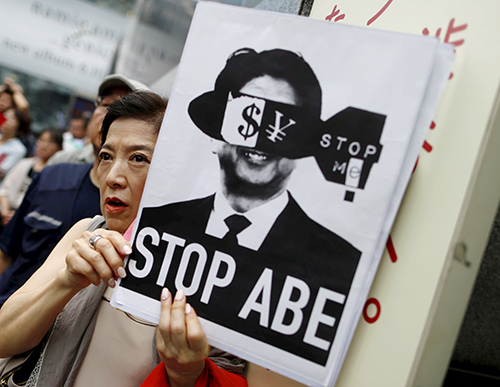
A protester holding a placard participates in a rally against Japanese Prime Minister Shinzo Abe's administration in Tokyo, Japan, June 27, 2015. Hundreds of people joined the demonstration on Saturday against Abe's policies in Tokyo's Shibuya area. [Photo/Agencies] |
In the midst of a huge public outcry in Japan, the two security bills that will enable Japan's Self-Defense Forces to participate in collective self-defense have now moved to the Upper House, having been approved by the Lower House on July 15.
The latest poll conducted by Nikkei and TV Tokyo shows that 57 percent of the respondents are against their passage during the current session of parliament, compared with only 26 percent in favor.
Japanese Prime Minister Shinzo Abe and his Liberal Democratic Party have been keen to sell a "China threat" to try and justify the need for the drastic change to the role of Japan's Self-Defense Forces.
At the Upper House hearing on Wednesday, Abe said Japan could conduct minesweeping operations in the South China Sea, an about-face that suggests his desire to expand collective self-defense into those waters, since he had previously told the Lower House, "It is possible to bypass the South China Sea."
He used to cite defense of US vessels should the need arise, as well as a minesweeping missions in the Strait of Hormuz, which is crucial for the supply of oil to Japan, as examples of the use of the right to collective self-defense.
The shift in scenario is an attempt by the Abe administration and the LDP lawmakers to emphasize the importance of enacting the controversial security bills during the current Diet session by positing a change in the security environment surrounding Japan due to China's rise.
Abe's cabinet approved this year's defense white paper, which painted a picture of serious security risks for Japan in an unstable region, and claimed China held accountable for the increase in threats.
In its 400-plus pages, the document devotes a significant portion to China's "high-handed" actions in the East China Sea and South China Sea. With Japan's Defense Minister Gen Nakatani claiming Japan needs to observe China closely.
Japan's English daily, Japan Times, hit the nail on the head when it said, "By highlighting the threat posed by China, the government appears to be trying to use the white paper to drum up public support for the Abe administration's controversial security legislation."
But the Abe administration has not stopped there. It released pictures of China's oil and gas exploration platform in waters that are not in dispute and fall under China's jurisdiction and called for a halt to their construction.
The photos were released only a week before the Upper House started debating the new security bills, showing how the Abe administration is trying to frighten the Japanese public into acceding to the changes he desires.
If it wants its people and the world to know the truth, it needs to tell them the consensus on the East China Sea issue, including oil and gas exploitation, that his country and China reached in 2008.
The main reason for his administration's finger-pointing at China is to try to convince the Japanese people to support Abe's security legislation. The LDP and its junior coalition partner, the Komeito Party, hope to pass the bills during the current session of parliament, which has been stretched from June 24 to September 27, the longest extension since World War II.
Japan Times has cautioned that if Japan plays up the threats posed by China and uses them as a pretext to beef up its military capabilities, China could use that as an excuse to respond in kind. "The result would be a ramping up of regional tension and a possible arms race."
The protests in front of the prime minister's office show that many Japanese people are not buying their government's excuses to expand the role of Japan's Self-Defense Forces.
Abe should not ignore them in blind pursuit of his personal ambitions for his country.
The author is China Daily's Tokyo bureau chief. caihong@chinadaily.com.cn



I’ve lived in China for quite a considerable time including my graduate school years, travelled and worked in a few cities and still choose my destination taking into consideration the density of smog or PM2.5 particulate matter in the region.
Copyright 1995 - . All rights reserved. The content (including but not limited to text, photo, multimedia information, etc) published in this site belongs to China Daily Information Co (CDIC). Without written authorization from CDIC, such content shall not be republished or used in any form. Note: Browsers with 1024*768 or higher resolution are suggested for this site.
License for publishing multimedia online 0108263 Registration Number: 130349