 |
|
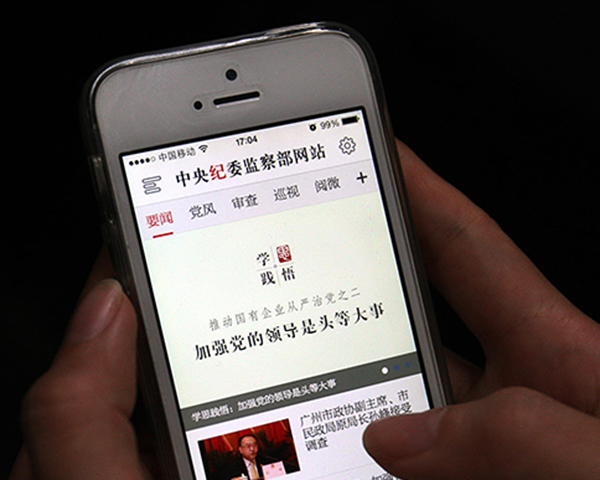
The free app of the Central Commission for Discipline Inspection, is available in Apple's App Store and in various Android stores, as well as on the commission's website. The app makes it easier for anyone to submit tipoffs about suspected corruption. WANG ZHUANGFEI/CHINA DAILY |
China's top leader Xi Jinping has highlighted the importance of the rule of law in the campaign against corruption, meaning that a shift from the top-down, mass movement anti-corruption efforts to institutionalized anti-corruption according to the law is in the making.
To regulate the anti-corruption work, the "top level design" will play a greater role in forging a transparent and just mechanism that supervises the use of public power.
This anti-corruption mechanism will focus on rooting out tolerance toward corruption and selective enforcement. In other words, all corruption-related cases, big or small, will be investigated in accordance with the law. Neither the "tigers", senior officials, nor the "flies", junior officials, will be allowed to get away with any misdeeds.
Driven by the spirit of the rule of law, such a mechanism will serve as a fundamental institutional guarantee of the healthy development of both the Party and the nation.
Of course, without a sound mechanism that is able to put power in cage, corruption is unlikely to be curbed. Therefore, both the nation's laws and Party regulations should work in a rigorous manner to effectively prevent and curtail corruption within the government and the Party.
According to Xi, the system to put power in a cage needs to be comprehensive. But for the time being, corruptions by a Party member that do not constitute crimes are mostly dealt with in accordance with the Party discipline, as the legislation now only applies to corruption crimes.
By emphasizing the need to build a comprehensive anti-graft system according to the law, Xi has made clear that the gap between Party discipline and the law should be bridged, and the legal loopholes sealed to make sure all corrupt officials are equally and duly punished. Only with stricter regulations can the authority of the Party discipline and the laws be bolstered.
In addition, the anti-corruption campaign according to the law is an open and inclusive practice, which is in accordance with global anti-graft governance. For instance, China needs to fully study the extradition laws in various countries, such as like the United States and Canada, so it can successfully extradite corrupt officials that have fled to those countries and recover the ill-gotten wealth they have transferred abroad.
Xi made it clear that corrupt officials should not be allowed to regard foreign countries as "safe havens".
At the Asia-Pacific Economic Cooperation summit in Beijing last November, the leaders of the Asia-Pacific Economic Cooperation economies agreed to establish a law enforcement cooperation network to hunt corrupt officials. The G20 Summit in Brisbane, Australia, which followed soon after, also witnessed the passage of the 2015-16 G20 Anti-corruption Action Plan. China's increasing participation in the global anti-graft efforts signals that it is determined to seek closer coordination with the criminal justice agencies of other countries.
Thanks to Xi's current strategic focus on "addressing the symptoms" of corruption in officialdom, a fundamental cure for the sickness in the body is gradually taking shape. Those who feared that the anti-corruption campaign may last for limited time, negatively affect China's economy, or exempt senior officials from their due punishments, should feel relieved to see what the anti-corruption campaign has achieved.
The author is deputy procurator-general of the Supreme People's Procuratorate.



I’ve lived in China for quite a considerable time including my graduate school years, travelled and worked in a few cities and still choose my destination taking into consideration the density of smog or PM2.5 particulate matter in the region.
Copyright 1995 - . All rights reserved. The content (including but not limited to text, photo, multimedia information, etc) published in this site belongs to China Daily Information Co (CDIC). Without written authorization from CDIC, such content shall not be republished or used in any form. Note: Browsers with 1024*768 or higher resolution are suggested for this site.
License for publishing multimedia online 0108263 Registration Number: 130349