 |
|
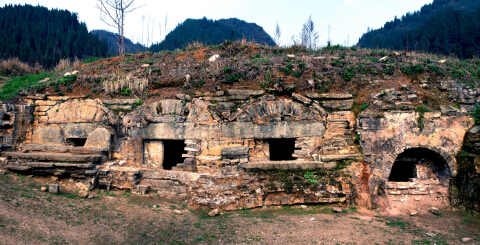
The Laosicheng ancient tombs which have been completely preserved have traces of the ancient time. |
"Laosicheng did it!" At the 39th session of UNESCO's World Heritage Committee on July 4, the Tusi sites of Laosicheng in Hunan, Tangya in Hubei and Hailongtun Fortress in Guizhou passed deliberation and voting and were inscribed on the World Heritage List.
For Hunan, it is especially significant in that Laosicheng was the first of its kind to be inscribed on the World Heritage List.
The Tusi site of Laosicheng in Yongshun, Hunan, located in Laosicheng Village, Lingxi Town that's more than 20km eastern of Yongshun Town, used to be an ancient town ruled by the Tusi regime for 800 years. From the 5th year of the reign of Emperor Shaoxing in the Southern Song Dynasty (1135) to the 6th year of the reign of Emperor Yongzheng in the Qing Dynasty (1724), it was the political, economic, military and cultural center of the Peng Tusi regime in Yongshun.
The Tusi site of Laosicheng covers a total area of 25 square kilometers, of which the town covers 250,000 square meters, and has huge ancient city walls and buildings on the surface. The site is made up of several parts, including the palace district, the government district, the streets, the tomb district, the religious district and the villa district. It was built in a desolate and barren mountainous area with a series of precipitous military passes and defense facilities mainly for a military purpose.
The mysterious Tusi regime was popular for hundreds of years in the Yuan, Ming and Qing dynasties, and reached its prime time in the Ming Dynasty. Throughout the process, the Tusi towns in Hubei set 29 Tusi in the Yuan Dynasty, 31 in the Ming Dynasty, and 20 in the Qing Dynasty.
Areas ruled by Tusi were mostly habited by the minorities. The central governments of the feudal dynasties, in order to strengthen the management of these areas, had taken conciliation policies since the Tang and the Song dynasties, carried out the system of setting government offices in these places to control them, that is, recognizing local nobles, conferring kinghood on them, and involving them into the administration of the central government. Since the Yuan Dynasty, the central governments had been applying the Tusi system of "using barbarous people to subjugate their own races." Till Emperor Hongwu in the Ming Dynasty, it provided that the Tusi "can pass the title to their descendents, has the right of life and death over people, needs to pay tributes to the central government, and shall be ready for requisition at any time."
The inscription of this ancient town on the World Heritage List just brings more glory to it. As the first site in Hunan to be inscribed on the World Heritage List, Laosicheng is of typical significance.


Copyright 1995 - . All rights reserved. The content (including but not limited to text, photo, multimedia information, etc) published in this site belongs to China Daily Information Co (CDIC). Without written authorization from CDIC, such content shall not be republished or used in any form. Note: Browsers with 1024*768 or higher resolution are suggested for this site.
License for publishing multimedia online 0108263 Registration Number: 130349