 |
|
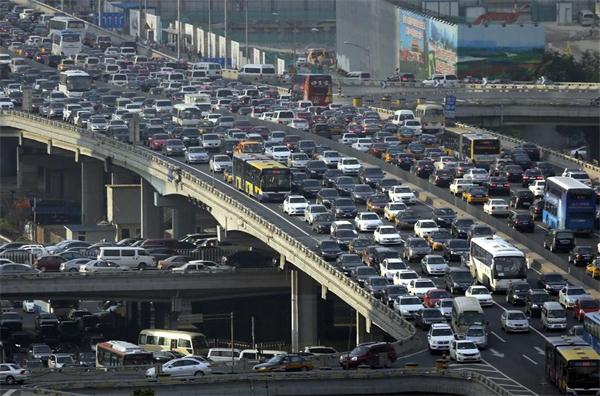
Lines of cars are pictured during a rush hour traffic jam on Guomao Bridge in Beijing. [Photo/Agencies] |
On June 30, the Chinese government issued its Intended Nationally Determined Contribution, announcing its actions to fight against and adapt to climate change in the post-2020 period. China has nationally determined its actions by 2030 as follows: to achieve the peaking of carbon dioxide emissions around 2030 and making best efforts to peak early; to lower carbon dioxide emissions per unit of GDP by 60 percent to 65 percent from the 2005 level; to increase the share of non-fossil fuels in primary energy consumption to around 20 percent; and to increase the forest stock volume by around 4.5 billion cubic meters over the 2005 level.
Even though China has become the world's largest carbon emitter and the second-largest economy, its main development indicators and its existing dual economy in urban and rural areas demonstrate that it is still a developing country, showing huge differences between China and developed countries in terms of stages of development, development needs, historical responsibilities and comprehensive capabilities. China's foremost strategic priority remains poverty reduction, raising incomes, increasing the level of social security, increasing the coverage of public services including basic infrastructure, raising the standard of living, etc.
Although it is clear that low-carbon growth is inevitable for China's future development, the country will face a number of challenges in achieving its INDC targets.
Accessibility to natural resources will increase the risk of failing the INDC targets. For example, clean energy such as natural gas is needed to replace coal consumption to meet the targets. A huge challenge in this process is how to ensure a sufficient and reliable supply of resources and guarantee national energy security while controlling costs.
As China is still in the process of industrialization and urbanization, heavy industrial sectors such as machinery manufacturing, iron and steel, construction materials and chemical industry still form a large share of its economy. Together with rapid urbanization, which comes with large scale infrastructure construction, this implies a constant increase in energy consumption and carbon emissions.
With the ratio of middle-class population rising over time, the emissions from transportation and buildings will increase accordingly, surpassing that of the manufacturing industry in the medium and long term. To realize the targets set in the INDC, it is vital to cultivate the young generation to adopt a low-carbon consumption model and lifestyle.
The question about the reliability of technology is another major challenge facing China in achieving its INDC objectives. For instance, China needs to address issues such as how to ensure renewable energy generation and reliability of the power grid, how to manage environmental impacts of hydropower and safety of nuclear power, and how to reduce the uncertainty of carbon capture and storage (CCS) technology.
As a developing country, China's overall technological level lags behind that of the developed world, with limited R&D capacity of key technologies, especially in low-carbon and adaptation technology. How to ensure access to technologies through effective international cooperation is vital to implementing the INDC targets.
To achieve mitigation and adaptation targets requires huge investment and construction costs. Some of the incremental investments bring about economic returns, while a majority of them are huge non-returnable economic costs, for example, the application of technologies like CCS. Besides economic costs, China may face social costs in the process such as structural unemployment caused by the closure of outdated production facilities, requiring measures to mitigate these social impacts.
The competence and capacities of key stakeholders in climate change are generally still limited, creating the heavy task of raising social awareness, and improving institutional and social mechanisms. China lacks macro management capacities to address climate change and its legislative and policy system in this area is still incomplete.
At present, China lacks a sound statistical and accounting system for greenhouse gas (GHG) emissions and is comparatively weak in monitoring, regulation and estimation of GHG emissions, as well as in law enforcement capacity. All of these shortcomings present challenges for China to realize its INDC targets.
The authors are with China National Center for Climate Change Strategy and International Cooperation.



I’ve lived in China for quite a considerable time including my graduate school years, travelled and worked in a few cities and still choose my destination taking into consideration the density of smog or PM2.5 particulate matter in the region.
Copyright 1995 - . All rights reserved. The content (including but not limited to text, photo, multimedia information, etc) published in this site belongs to China Daily Information Co (CDIC). Without written authorization from CDIC, such content shall not be republished or used in any form. Note: Browsers with 1024*768 or higher resolution are suggested for this site.
License for publishing multimedia online 0108263 Registration Number: 130349