 |
|
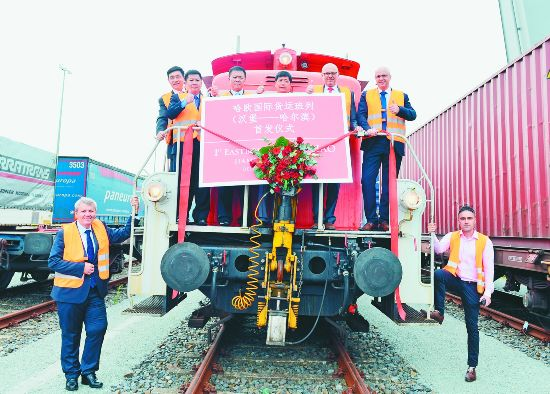
A freight train prepares to leave Hamburg en route to Harbin, June 27. [Photo provided to China Daily] |
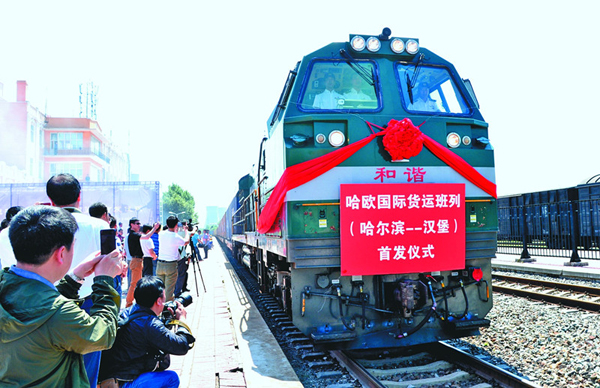
A freight train hauling 49 containers of cargo worth $3 million began a 9,820-km journey from Harbin, Heilongjiang province to the German port city of Hamburg.
It entered Russia from Manzhouli, Inner Mongolia, joined the Trans-Siberian railway line and then headed to Yekaterinburg, Moscow and Poland before arriving a fortnight later.
That same day, a train laden with auto parts, beer and consumer goods left Hamburg, bound for Harbin. What's the connection?
It's a new cargo service created in response to China's new "Belt and Road Initiative" intended to revive the glories of the ancient Silk Road trade route by building a China-Mongolia-Russia Economic Corridor and the Heilongjiang Land and Maritime Silk Road Economic Belt.
Harbin has long been considered an open, international city going back to the late 19th century, but at that time Russia's Tsarist government railway line in Northeast China was used to plunder its resources and control the Far East. The line extended eastward to the Pacific Ocean and westward to Europe, with Harbin as a hub. The city was created largely due to the railway as it brought an influx of foreign immigrants, business and prosperity to the city.
 |
|
A train departs Harbin for Hamburg, June 13. [Photo provided to China Daily] |
The line is part of China's Silk Road Economic Belt running across Asia to Europe and 21st Century Maritime Silk Road, running to Africa.
Peng Jielin, deputy head of Heilongjiang's development and reform commission, said cargo going to Europe from China's Pearl River Delta, Yangtze River Delta and Bohai-Sea areas will cost less than goods transported through the Xinjiang Uygur region or via the city of Erenhot in Inner Mongolia. The weekly train service is also more economical, convenient and safer. It takes 15 days fewer than by sea and costs about $2,000 less than other railway routes.
By the end of this year, the train is expected to have made 26 trips, carrying goods from major cities and ports in Liaoning, Jilin and Heilongjiang provinces in the Northeast, the Bohai area in the North and East, as well as Japan and South Korea, accounting for about 50 percent of the cargo. Meanwhile, cargo from Germany, Poland, the Czech Republic, France, Hungary and Spain will head this way, providing a door-to-door delivery service both ways.
Wang Fukuan, deputy head of Harbin Customs, said the train will open a new logistics channel for China's imports and exports and promote economic and trade cooperation among China, Russia and Europe. It can also bring more resources, technology and capital to Heilongjiang for production and development of trade and industries along the line.


Copyright 1995 - . All rights reserved. The content (including but not limited to text, photo, multimedia information, etc) published in this site belongs to China Daily Information Co (CDIC). Without written authorization from CDIC, such content shall not be republished or used in any form. Note: Browsers with 1024*768 or higher resolution are suggested for this site.
License for publishing multimedia online 0108263 Registration Number: 130349