 |
|
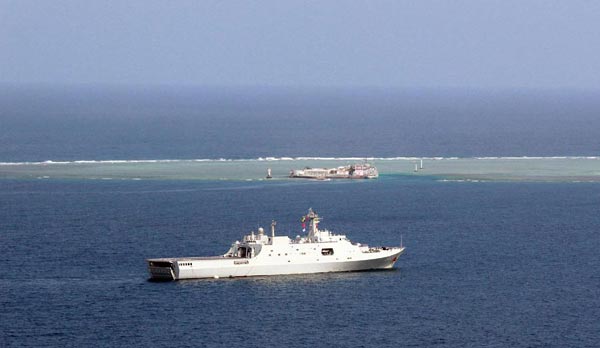
China firmly upholds her sovereignty and maritime rights and interests in the South China Sea. [Photo/Xinhua] |
Recent US rhetoric and moves on the South China Sea issue reflect its double standards. Its rhetoric is aimed at exaggerating the situation in the South China Sea to gain support for its "pivot to Asia" policy and prompt joint action against China by its neighbors, especially the Philippines and Japan, which have territorial disputes with China. And its actions are aimed at cornering China to "settle scores" after having miscalculated the effects of the China-proposed Asian Infrastructure Investment Bank. In other words, they reflect the US' rising worries over China's rise and the possibility of losing its supremacy in world affairs.
Without any legitimate stakes, the US has been trying to interfere in the South China Sea disputes on the fragile grounds of international laws and freedom of navigation. But such pretexts cannot convince people familiar with the real situation.
To begin with, the US, despite being a non-claimant state, has been devoting disproportionate attention to the issue to tilt the balance in favor of its allies. It has been talking about international laws, yet it has not ratified the UN Convention on the Law of the Sea. Is that adherence to international law?
For the US, "freedom of navigation" actually means "freedom to dominate the waters, lead the Asia-Pacific region and challenge China's sovereignty". In fact, by extending its arm all the way across the Pacific Ocean to the South China Sea, an area very much at China's doorstep, the US is only demonstrating its hegemonic designs.
On my most recent trip to the US for think tank discussions, I made one point clear: The US does not have any moral justification whatsoever to interfere in the South China Sea disputes.
The US' moves have met a solid and unyielding response from a confident China. In a broader sense, what is unfolding in the South China Sea between China and the US is proof that the latter is eager to reassert its supremacy in the Asia-Pacific as it shifts toward a new regional security order. Such an attempt, however, could throw the US off its strategic balance.
First, the US could lose the balance between its allies and China. Countries like the Philippines will not miss such opportunities to reap benefit at the expense of China-US ties. And in the end, the US could lose China as a partner and find itself in a strategic dilemma.
Second, the US could lose the balance between its two strategic focal points: Asia-Pacific and the Middle East. Asked whether the "pivot to Asia" policy requires US withdrawal from the Middle East, US Senator John McCain only said that if the US chose to do so, the world would question its ability and credibility.
And third, the US could lose the balance between responding to the traditional challenge of the rise of emerging powers and the non-traditional challenge of Islamic extremism. McCain admitted that the US seems to be losing the fight against the Islamic State, saying the Barack Obama administration needs to send ground troops to the Middle East to turn the tide.
The author is a research fellow at and deputy director of the Institute of World Politics, China Institutes of Contemporary International Relations.
Courtesy: China & US Focus



I’ve lived in China for quite a considerable time including my graduate school years, travelled and worked in a few cities and still choose my destination taking into consideration the density of smog or PM2.5 particulate matter in the region.
Copyright 1995 - . All rights reserved. The content (including but not limited to text, photo, multimedia information, etc) published in this site belongs to China Daily Information Co (CDIC). Without written authorization from CDIC, such content shall not be republished or used in any form. Note: Browsers with 1024*768 or higher resolution are suggested for this site.
License for publishing multimedia online 0108263 Registration Number: 130349