 |
|
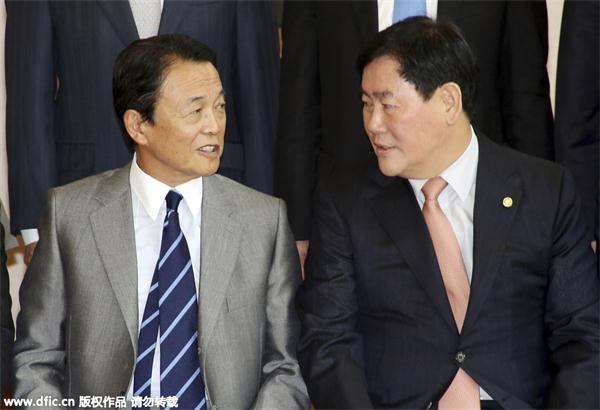
Japan's Deputy Prime Minister Taro Aso, left, and South Korea's Strategy and Finance Minister Choi Kyung-hwan chat prior to the 6th Japan-Korea Finance Dialogue in Tokyo, Saturday, May 23, 2015. |
As US allies in East Asia, Japan and South Korea should get along much better than they do. But they will have little to celebrate when they hold events commemorating the 50th anniversary of the normalization of their relations on Monday.
Relations between them are strained because of a territorial dispute, conflicting views over Japan's colonial rule of the Korean Peninsula from 1910 to 1945 and the so-called comfort women issue.
South Korea's Foreign Minister Yun Byung-se visited Japan on Sunday, the first visit by a South Korean foreign minister in four years, for the commemoration. Japanese Prime Minister Shinzo Abe and South Korean President Park Geun-hye have not had a formal one-on-one meeting since they took office.
In 1965 the US strongly urged Tokyo and Seoul to conclude the treaty on normalizing ties to form a united front against communists in East Asia. The agreement was not the fruit of reconciliation, therefore; it was simply a product of the Cold War. Such a framework has blanketed the deep-rooted problems the two have.
The modern history of South Korea's relations with Japan has been traumatic for the former, as Japan ruled the Korean Peninsula heavy-handedly from 1910 to 1945.
Some 80 percent of about 200,000 women tricked, coerced, or abducted by the Japanese military into sex slavery or prostitution to "comfort" Japanese troops before and during the World War II were Korean.
The South Korean government has claimed that at least 1 million of its citizens were mobilized to Japan. Most of them forced to work in Japan's coal-mining regions, munitions factories, dam-construction sites and other places.
Up to now, Japan has refused to pay damages to the "comfort women" and forced laborers, saying it settled those issues on a government-to-government basis in the form of economic cooperation under the normalization treaty in 1965.
But the South Korea claims that this is not the case.
The differences between them allow the issues of history to flare up time and again.
Mutual dislike remains high. An April poll found 73 percent of the South Koreans interviewed hold a negative view of Japan, up from last year's 71 percent. Only 16 percent said they have a positive view of Japan, down from 18 percent last year. Japanese who hold a negative view toward South Korea dropped slightly to 52 percent from 54 percent in 2014.
Japan's Foreign Ministry has deleted a description of South Korea as sharing "fundamental values such as freedom, democracy and a market economy" on its website. The new text calls South Korea Japan's "most important neighboring country".
The ministry tried to play down the significance of the revision, but political pundits said the move is "petty" and a telling sign that relations are souring as the two governments are at loggerheads over political and historical issues.
South Korean President Park has suggested resolving the historical issues as a precondition to improving Seoul-Tokyo relations. In her speech on the 60th anniversary of Memorial Day on June 6, Park said, "(South) Korea and Japan have failed to take a step forward in improving bilateral relations due to territorial disputes and historical issues, such as Tokyo's sexual enslavement of Korean women during World War II."
"We will meet every obstacle undauntedly and resolve these problems," Park said.
Japan has chosen to take Park's words as a willingness to improve ties.
The two countries have held a series of talks on finance, trade and defense at the ministerial level, but the strains of the relationship are not likely to be eased any time soon.
For its future, Japan's diplomacy toward its neighbors is of vital importance, but there is little debate in the country on this vital issue.
The author is China Daily's Tokyo bureau chief. caihong@chinadaily.com.cn



I’ve lived in China for quite a considerable time including my graduate school years, travelled and worked in a few cities and still choose my destination taking into consideration the density of smog or PM2.5 particulate matter in the region.
Copyright 1995 - . All rights reserved. The content (including but not limited to text, photo, multimedia information, etc) published in this site belongs to China Daily Information Co (CDIC). Without written authorization from CDIC, such content shall not be republished or used in any form. Note: Browsers with 1024*768 or higher resolution are suggested for this site.
License for publishing multimedia online 0108263 Registration Number: 130349