 |
|
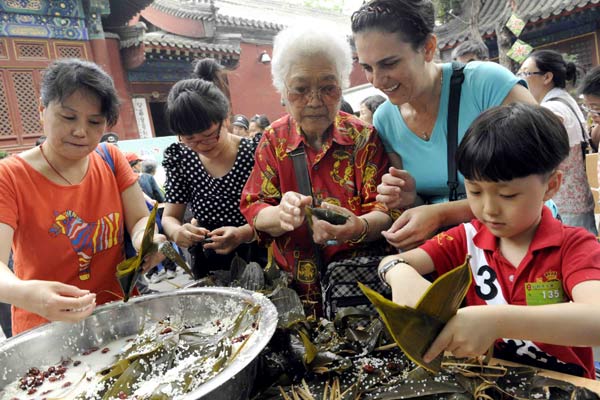
Beijing residents get their hands dirty making zongzi (rice parcels) at Dongyue Folklore Museum in Chaoyang district on June 7, 2011. The snack is traditionally eaten during Dragon Boat Festival, or Duanwu Jie, which falls on the fifth day of the fifth month on the Chinese lunar calendar. PHOTO BY ZHANG QIN / FOR CHINA DAILY |
It is widely believed that zongzi, or rice dumpling, is the only traditional symbol that has remained attached with the Dragon Boat Festival.
Festival and food are made for each other in China. Therefore, Chinese cultural authorities should apply for a UNESCO Intangible Cultural Heritage title for Chinese food to better convey the message of traditional Chinese culture.
French food was recognized as a UNESCO Intangible Cultural Heritage in 2010. The recognition or listing has nothing to do with a country's cuisine — nothing to do with the variety of dishes and cooking techniques — instead it associated with the cultural tradition of eating and drinking.
In the case of France, the title was bestowed on the flamboyance of its gastronomy (the dressing of the table, the pairing of certain wines with certain dishes, the placement of glasses and cutlery, the artistry and presentation of a multi-course meal). In the communiqué, UNESCO lauded the traditional French meal as a "social custom aimed at celebrating the most important moments in the lives of individuals and groups".
China too has rich and elaborate food customs, arguably richer than most other countries, even France perhaps. In China, an array of dishes is placed on round tables with elevated, revolving surfaces that cover the core of the table (the purpose of the revolving table is to allow every diner access to all the dishes as the elevated part is nudged along in circles).
The ritual starts with the dressing of the table — each person gets a saucer and a bowl, a pair of chopsticks, a cup for tea and a shot glass for alcohol — and continues with the progress of the meal. After waiters fill the cups with tea, the diners raise a toast before tucking into the food.
The first wave is of cold dishes, followed by a variety of hot (as in temperature) dishes, with steamed rice being served toward the end. The array of Chinese dishes is impressive, varying according to ingredients, cooking techniques and flavors, than in any other cuisine.
At Chinese banquets or social dinners, the ritual also extends to the way people toast one another — the way the glass is held at a lower or higher level while clinking signifies social rank and/or seniority.
And the use of chopsticks itself is the embodiment of finesse, a fine tradition passed down generations (it takes a foreigner in China about six months of practice to learn how to use chopsticks with dexterity).
It's also a tradition that goes back hundreds of years — at the Shaanxi Historical Museum in Xi'an there is a mural of a banquet that's 1,300 years old, unearthed from a royal tomb of the Tang Dynasty — making the Chinese social meal a sophisticated tradition that deserves to be listed as a UNESCO Intangible Cultural Heritage.
The author is a writer who has been keenly researching and writing about China for a decade.
(China Daily 06/17/2015 page9)



I’ve lived in China for quite a considerable time including my graduate school years, travelled and worked in a few cities and still choose my destination taking into consideration the density of smog or PM2.5 particulate matter in the region.
Copyright 1995 - . All rights reserved. The content (including but not limited to text, photo, multimedia information, etc) published in this site belongs to China Daily Information Co (CDIC). Without written authorization from CDIC, such content shall not be republished or used in any form. Note: Browsers with 1024*768 or higher resolution are suggested for this site.
License for publishing multimedia online 0108263 Registration Number: 130349