 |
|
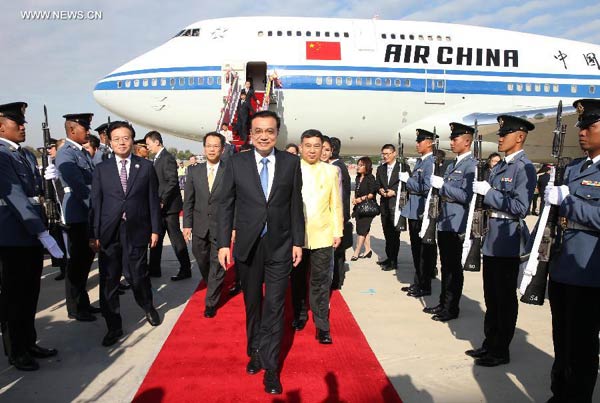
Chinese Premier Li Keqiang (C, front) arrives in Bangkok, Thailand, Dec. 19, 2014. Li arrived here Friday to attend the fifth summit of the Greater Mekong Subregion (GMS) Economic Cooperation. [Photo/Xinhua] |
Twenty-five years ago, Yunnan province was one of China's most isolated and impoverished regions, due to its inland location and mountainous terrain. Its roads were poor, its communication infrastructure was underdeveloped, and trade with southern neighbors was negligible.
Today Yunnan's capital, Kunming-the grand city of "merchants and artisans" described by Marco Polo-is reclaiming its position as a major regional trade hub. Commerce is once again thriving, and people are prospering like never before.
Improved connectivity has been a cornerstone of Yunnan's transformation. The narrow trails traveled by 13th century traders have given way to modern expressways that are driving trade. As recently as 1990 it was virtually impossible to ship goods overland from Yunnan to nearby Thailand, necessitating a six-week journey, via Hong Kong, to reach Bangkok. Today it takes just two days, and overland trade between Yunnan and its neighbors is booming.
Yunnan has played a pivotal role in the Greater Mekong Subregion (GMS). Since 1992 the six GMS nations sharing the Mekong River - Cambodia, China (specifically Yunnan province and Guangxi Zhuang autonomous region), Laos, Myanmar, Thailand, and Vietnam - have pursued a program of economic cooperation and improved connectivity to foster greater prosperity to the subregion.
Under this program, two modern expressways - one stretching from Kunming through Laos and on to Bangkok, and the other from Kunming to Hanoi - have been developed, forming the backbone of the GMS north-south economic corridor, a key building block in an Asia-wide tapestry of trade routes that are propelling the region's economic growth.
The challenge now facing GMS countries is cutting the red tape. One-stop customs and harmonized quarantine administration need to be introduced at all borders to ensure goods, people and vehicles can move freely. Logistics need to be improved, and GMS nations must create a better business environment that encourages the private sector to more actively invest in trade and industry.
Progress is already being made on these fronts. Today Mekong nations are planning the next quantum leap forward - a new era where goods and people will easily crisscross borders, and where a new communication superhighway network will give rise to thriving e-commerce between GMS nations. If GMS countries continue to make meaningful strides on these fronts, their progress over the next quarter century should be every bit as impressive as the last.
Perhaps the most important legacy of the GMS economic corridors is the role they have played in transforming the lives of people living along them. Since the completion of the Kunming-to-Bangkok route, for example-a modern highway cutting through a previously isolated corner of Laos-communities all along the corridor have been reaping enormous benefits. The old road was narrow and virtually impassible during the rainy season. The new all-weather road provides a crucial lifeline, giving families in the 76 villages along the route better access to life-saving health services and better jobs. It is making it easier for children to get to school, improving enrolment and retention rates.
Tourist visits are also skyrocketing, providing a new source of income and a much better of standard of living for people in countless villages. All along the road, families once bound to a life of poverty due to their isolation can now tap new opportunities. Earnings for families along the corridor are now 50 percent higher than other households' earnings, enabling many families to finally escape the poverty trap.
Just as the ancient Silk Road promoted interchange and better understanding between Chinese, Southeast Asian, central Asian and Western civilizations, so too can new economic corridors serve as a catalyst for greater connectivity between nations, and stronger bonds between their peoples. Through better cooperation, connectivity and mutual understanding, the GMS program-in tandem with other initiatives in central and south Asia - can help pave the way for a new age of prosperity, innovation and progress.
The author is the Asian Development Bank's vice-president for East Asia, Southeast Asia and the Pacific.



I’ve lived in China for quite a considerable time including my graduate school years, travelled and worked in a few cities and still choose my destination taking into consideration the density of smog or PM2.5 particulate matter in the region.
Copyright 1995 - . All rights reserved. The content (including but not limited to text, photo, multimedia information, etc) published in this site belongs to China Daily Information Co (CDIC). Without written authorization from CDIC, such content shall not be republished or used in any form. Note: Browsers with 1024*768 or higher resolution are suggested for this site.
License for publishing multimedia online 0108263 Registration Number: 130349