 |
|
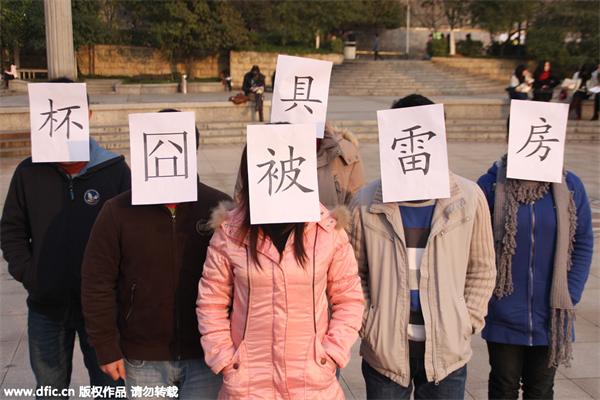
Chiense netizens grant some Chinese characters new meanings. [Photo/IC] |
What happens when gaokao collides with the Internet? One consequence is the demise of Internet language, at least in Henan and Guangdong provinces.
Before the two-or three-day gaokao (or national college entrance exam) from Sunday, the two provinces' education authorities specifically forbade students from using "Internet language" in the exam. This shows how reluctant some educators are to accept the flow of the times.
All languages, including Chinese, have to keep evolving or they would die. True, the modern Chinese language has its origin in ancient Chinese, but it has kept developing by absorbing words and expressions from other languages. For example, The True Story of Ah Q by Lu Xun (1881-1936), which is part of Chinese textbooks, has an important remark on the impact of foreign language.
Whether we like it or not, the "Internet language" has remodeled modern Chinese since the Internet has affected every aspect of people's life. Official data show that by the end of 2014, China had 649 million Internet users.
It is impossible to eradicate the Internet language because many new words and phrases created in the virtual have become part of our everyday life. In fact, it is difficult to distinguish between many Internet and non-Internet words. Can educators suggest alternatives for the Internet terms such as yingjian (hardware), ruanjian (software), dianshang (electronic business) and yunduan (cloud)?
Moreover, there are many newly created quip-like words, phrases and even marks; also, some old Chinese characters have been given new meanings. The original meaning of 囧 (jiong) is bright, but now people use it to describe "depressed" or "embarrassed" because the character looks like a worried face.
Educators have to be more tolerant toward "Internet words" that have already become part of the spoken language. No etymologist, philologist or grammarian has said taozhiyaoyao should be used only in its original meaning to describe beautiful blossoms. Nowadays, the term means "flee" even in Chinese textbooks.
Top leader Xi Jinping attaches great importance to the role of the Internet in the life and development of the youth. He himself has a simple speaking and writing style. In his New Year address in 2015, Xi used popular online phrases, such as manpingde (or give one's best shot) to praise officials at different levels for their hard work and dianzan (or thumbs-up) to thank the great Chinese people for their support. And as expected, Chinese youth applauded his speech.
Educators would do well to follow Xi's example and become more open-minded to new developments, instead of trying to fend off anything and everything new. Indeed, the Internet has given birth to some dirty words too and they should be banned. At a conference just last week, the National Internet and Information Office listed 25 dirty "online phrases", some of which are quite familiar to netizens. The conference also saw some experts expressing concerns over some dirty words that students often use in their compositions.
For the benefit of teenagers, such words should be banned from school texts and answer scripts. Netizens too should be warned to never use the 25 banned words.
But there is no justification in banning the use of all words and phrases the Internet has helped create, especially if they have been accepted by one and all.
The author is an editor with China Daily.


Copyright 1995 - . All rights reserved. The content (including but not limited to text, photo, multimedia information, etc) published in this site belongs to China Daily Information Co (CDIC). Without written authorization from CDIC, such content shall not be republished or used in any form. Note: Browsers with 1024*768 or higher resolution are suggested for this site.
License for publishing multimedia online 0108263 Registration Number: 130349