 |
|
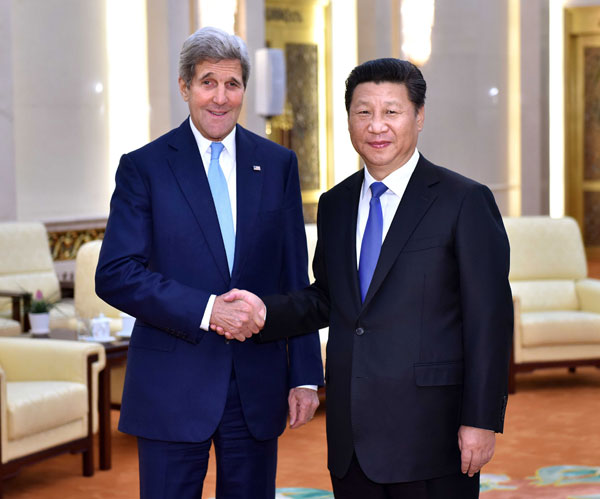
Chinese President Xi Jinping (R) meets with US Secretary of State John Kerry at the Great Hall of the People in Beijng, capital of China, May 17, 2015. [Photo/Xinhua] |
Rivalry between great powers doesn't always have to generate super friction. Competition can produce excellence, even a good new idea. A prime example is the Asian Infrastructure Investment Bank.
While almost everyone liked the AIIB proposal from the start, the United States not only criticized it, but also pressured its allies not to join it. After all, it wasn't its idea - it was China's. So what? Even the United Kingdom, with its so-called "special relationship" with the US, was enthusiastic. Probably, other good ideas will come from China - maybe even an idea for taming the South China Sea tempest. Then reason could rule the waves and the mad struggle for resources funneled into channels of diplomacy.
But one major impediment to mutual understanding and appreciation is the American media. On this issue its reportage has been horrible - one-sided and ideological.
Why relentlessly portray China as some giant shark of evil, a la Jaws, and the US as some Moby Dick of goodness? It's a morally complex jungle out there; real geopolitical life is just not that binary-simple.
China - we note for the purposes of historical accuracy and fairness - formally ratified the United Nations Convention on the Law of the Sea for all nations a long time ago, but the US still withholds ratification. Over the years obstructionists in the US Senate have withheld formal ratification on the grounds that American interests might not have unimpeded sway due to UNCLOS. The whole point of international laws is that they are designed to compel compliance by all nations, and not play favorites. That's the good news.
The bad news is that it's a tough argument to induce China or anyone else to "observe international norms" if the main purpose of the "norms" is simply to seek to maintain the international geopolitical status quo. That will be very difficult to do in an age when Asia as a whole - not just China - is rising dramatically. Any nation that thinks the status it enjoyed in the 20th century will be the very same in this century had better think again.
Leadership from both Washington and Beijing will require a clear-eyed understanding of the other. If China's policy is based on the assumption of a steep American decline, then its moorings are shaky indeed; if the US' policy is predicated on the same old China to be kept in its place, then someone has been hooked on heavy sleeping pills. The task of statesmanship is to accommodate the inevitability of China in a manner that maximizes everyone's interests - and avoids war.
The worst American policy would be one of hypocrisy: Oppose a good idea like the AIIB for self-serving reasons and force a simple-minded Cold War analytic framework on South China Sea issues that don't fit contemporary reality. And it is here that you worry: further high-profile American involvement could push the South China Sea issue into that dreaded superpower showdown that no one wants.
Rather than raise its South China Sea profile, the US should bob and weave out there with the utmost care, no matter how allegedly saintly its intentions. Asia watcher Bill Hayton, in his invaluable new book The South China Sea, quotes a well-regarded Asian diplomat as warning: "If you bring in one superpower to oppose the other, then superpower dynamics begins to push the issue and marginalizes a peaceful settlement." He has got that down right.
The author, a former editor of the editorial pages of the Los Angeles Times and founder of Asia Media International, is Loyola Marymount University's distinguished scholar of Asian and Pacific Studies.



I’ve lived in China for quite a considerable time including my graduate school years, travelled and worked in a few cities and still choose my destination taking into consideration the density of smog or PM2.5 particulate matter in the region.
Copyright 1995 - . All rights reserved. The content (including but not limited to text, photo, multimedia information, etc) published in this site belongs to China Daily Information Co (CDIC). Without written authorization from CDIC, such content shall not be republished or used in any form. Note: Browsers with 1024*768 or higher resolution are suggested for this site.
License for publishing multimedia online 0108263 Registration Number: 130349