 |
|
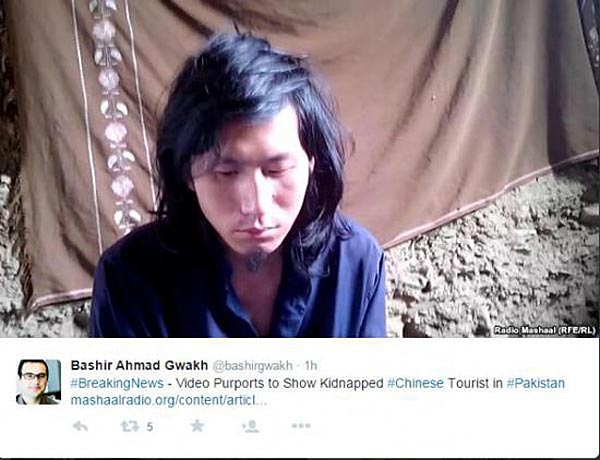
Hong Xudong allegedly shown in a video released by militants in this screenshot grabbed from the Twitter account of journalist Bashir Ahmad Gwakh who covers a wide range of political and military issues in Afghanistan and Pakistan. |
A video recently released by an extremist group allied to the Taliban shows a Chinese national resembling Hong Xudong, who was adducted by militants from the northwestern region of Pakistan in May 2014, seeking the Chinese government's help to get him released. The militants, however, have not cited an exact amount as ransom.
Hong entered Pakistan from India by bicycle in April last year, and was abducted a month later from Dera Ismail Khan district in Khyber Pakhtunkhwa province, which borders Pakistan's tribal regions and are home to a number of militant groups.
The Chinese embassy in Pakistan has reportedly approached the Pakistani authorities to verify the man seen in the video, and Pakistani Prime Minister Nawaz Sharif has issued directives to the Interior Ministry and other departments to coordinate for the early release of the Chinese national.
China today has more resources to protect its nationals overseas. In March, for instance, the Chinese government launched a massive operation to evacuate Chinese nationals from war-torn Yemen. But when overseas rescue operations could turn out to be complicated, which the one in Pakistan is likely to be, should the government act instantaneously to protect its nationals regardless of the risks and expenses involved? In other words, should it give in to the demand of the militants?
It is very important to first ensure whether the Chinese government or the Pakistani government is obliged to pay the ransom. This being said, the Chinese government's legal obligation largely depends on what led to the abduction. If Hong was kidnapped while conducting official business, it is Beijing's responsibility to save him. If not, the government can act only on humanitarian and political grounds, instead of launching a mission that needs to be completed at all costs.
The Pakistani government, on the other hand, has only the moral obligation to intervene in the matter, because Hong cycled his way to Dera Ismail Khan despite the ban on foreigners traveling to the restive region without security.
This is not to say, Beijing should stand by and allow a Chinese national's life to be held to ransom. But it needs to consider the possibility of more Chinese tourists being abducted in a foreign country if the Taliban's request for money is met. The dilemma is, using public funds usually comes at a price. Yet by refusing to save the Chinese national's life, Beijing could be accused of acting irresponsibly.
China is indeed financially capable of meeting the terrorists' demand to secure the freedom of the young Chinese tourist. The latent danger of doing so is rather obvious: after getting the money from Beijing, the Taliban forces in Pakistan can be emboldened to abduct more Chinese nationals and launch even bigger terrorist attacks not only in Pakistan, but also in other countries. Worse, Beijing's gesture may send a wrong message to other terrorist groups - that abducting Chinese nationals is a highly profitable business, which could threaten the safety of more Chinese people abroad.
Of course, there is more that Beijing and Islamabad could do to save Hong's life. For example, they could ask local tribal and religious leaders to persuade the terrorists to free him, or, encourage the Pakistani military to send a stern warning to the terrorist group. Such moves may cost more than simply paying the ransom to the terrorist group, but they are more suited to helping resolve future cases.
The author is a researcher at the National Institute of International Strategy, affiliated to the Chinese Academy of Social Sciences.
(China Daily 05/28/2015 page9)



I’ve lived in China for quite a considerable time including my graduate school years, travelled and worked in a few cities and still choose my destination taking into consideration the density of smog or PM2.5 particulate matter in the region.
Copyright 1995 - . All rights reserved. The content (including but not limited to text, photo, multimedia information, etc) published in this site belongs to China Daily Information Co (CDIC). Without written authorization from CDIC, such content shall not be republished or used in any form. Note: Browsers with 1024*768 or higher resolution are suggested for this site.
License for publishing multimedia online 0108263 Registration Number: 130349